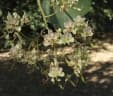
Bauhinia roxburghiana
Bauhinia roxburghiana
Safety & Hazards
None known
Cultivation Details
A plant of the subtropics to tropics. In its natural habitat the plant experiences an absolute maximum shade temperature from 35 - 45°c., an absolute minimum of -2 - +5°c; and a mean annual rainfall from 1,000 - 2,250mm[1]. Prefers a fertile, moisture-retentive but well-drained soil and a position in full sun[2]. Tolerates poor, stony ground[1]. The tree can be coppiced[1]. This species has a symbiotic relationship with certain soil bacteria, these bacteria form nodules on the roots and fix atmospheric nitrogen. Some of this nitrogen is utilized by the growing plant but some can also be used by other plants growing nearby[2]
Propagation
Seed - pre-soak for24 hours in warm water then sow in situ. Cuttings of half-ripe wood, with the leaves removed, placed in moist sand[2]. Cite as: Tropical Plants Database, Ken Fern. tropical.theferns.info. 2026-02-19. <tropical.theferns.info/viewtropical.php?id=Bauhinia+roxburghiana>
Pollinators
Data unavailable
References
- [1]The Silviculture of Indian Trees — Troup. R.S. · Oxford, at the Clarendon Press · 1921 · http://www.biodiversitylibrary.org ↩︎An excellent treatment.
- [2]The New RHS Dictionary of Gardening. 1992. — Huxley. A. · MacMillan Press · 1992 · ISBN 0-333-47494-5 ↩︎Excellent and very comprehensive, though it contains a number of silly mistakes. Readable yet also very detailed.
- [3]A Manual of Indian Timbers. — Gamble. J. S. · Bishen Singh Mahendra Pal Singh · 1972 · ISBN - ↩︎First written in the 19th century, but still a classic, giving a lot of information on the uses and habitats of Indian trees. Not for the casual reader.
- [4]Dictionary of Economic Plants. — Uphof. J. C. Th. · Weinheim · 1959 · ISBN - ↩︎An excellent and very comprehensive guide but it only gives very short descriptions of the uses without any details of how to utilize the plants. Not for the casual reader.
- [5]Cornucopia II — Facciola. S. · Kampong Publications, California. · 1998 · ISBN 0-9628087-2-5 ↩︎The second edition of an excellent guide to the edible uses of plants, though it does not give any details of cultivation etc.
- [6]Flora of Pakistan — http://www.efloras.org ↩︎As of 2006, there is not much information on habitats available, but it is being developed and promises to be an excellent resource.
- [7]The Leguminosae; A Source Book of Characteristics, Uses and Nodulation — Allen O.N.; Allen E.K. · University of Wisconsin · 1981 · ISBN 0-333-32221-5 ↩︎An amazing and comprehensive work, giving a brief guide to the many genera of the family Fabaceae and also the principle uses of the genus.