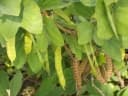
Bauhinia racemosa
Bauhinia racemosa
Safety & Hazards
None known
Cultivation Details
A plant of dry to moist areas of the tropics and subtropics. In its natural habitat the absolute maximum shade temperature it experiences varies from 38 - 48°c, the absolute minimum from -1 - +11°c. The mean annual rainfall ranges from 750 - 2, 125mm[1]. Grows best in a sunny position[2, 1]. Prefers a fertile, moisture-retentive but well-drained soil[2]. Young plants grow quite rapidly and also form side-branches in the first year of growth. Under ideal conditions, the side branches can be 1 metre long by the end of the first year's growth[1]. Irrigated plants can be 4.5 metres tall within 3 years[1]. Although many species within the family Fabaceae have a symbiotic relationship with soil bacteria, this species is said to be devoid of such a relationship and therefore does not fix atmospheric nitrogen[3].
Propagation
Seed - pre-soak for24 hours in warm water then sow in situ or in a nursery seedbed. Germination rates of 1 year old seed can be from 58 - 95%[1]. Young plants grow rapidly and quickly produce a taproot that can be 60cm long within 2 months of germination[1]. Plants are not very tolerant of transplanting unless moved whilst still quite small[1]. Cuttings of half-ripe wood, with the leaves removed, placed in moist sand[2]. Cite as: Tropical Plants Database, Ken Fern. tropical.theferns.info. 2026-02-19. <tropical.theferns.info/viewtropical.php?id=Bauhinia+racemosa>
Pollinators
Data unavailable
References
- [1]The Silviculture of Indian Trees — Troup. R.S. · Oxford, at the Clarendon Press · 1921 · http://www.biodiversitylibrary.org ↩︎An excellent treatment.
- [2]The New RHS Dictionary of Gardening. 1992. — Huxley. A. · MacMillan Press · 1992 · ISBN 0-333-47494-5 ↩︎Excellent and very comprehensive, though it contains a number of silly mistakes. Readable yet also very detailed.
- [3]Nodulation Plants in GRIN Taxonomy — United States Department of Agriculture · http://www.ars-grin.gov/~sbmljw/cgi-bin/taxnodul.pl?language=en ↩︎An online database listing plants that have either positive or negative reports on root and stem nodulation with nitrogen-fixing bacteria.
- [4]Flora of Pakistan — http://www.efloras.org ↩︎As of 2006, there is not much information on habitats available, but it is being developed and promises to be an excellent resource.
- [5]Flora of China — Missouri Botanical Garden Press; St. Louis. · 1994 · http://flora.huh.harvard.edu/china/ ↩︎An excellent, comprehensive resource in 25 volumes. In addition to the botanical information the flora also gives basic information on habitat and some uses. An on-line version is also available.
- [6]Cornucopia II — Facciola. S. · Kampong Publications, California. · 1998 · ISBN 0-9628087-2-5 ↩︎The second edition of an excellent guide to the edible uses of plants, though it does not give any details of cultivation etc.
- [7]A Manual of Indian Timbers. — Gamble. J. S. · Bishen Singh Mahendra Pal Singh · 1972 · ISBN - ↩︎First written in the 19th century, but still a classic, giving a lot of information on the uses and habitats of Indian trees. Not for the casual reader.
- [8]Useful Fiber Plants of the World — Dodge C.R. · USDA; Washington. · 1897 · http://www.biodiversitylibrary.org/ ↩︎A rather dated, but very comprehensive catalogue of fibre plants from around the world. The book can be downloaded from the Internet.
- [PFAF]Plants for a Future — pfaf.org ↩︎