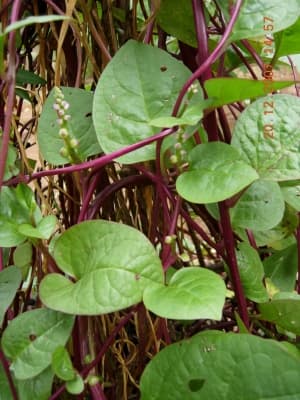
Basella alba
Basella alba
Safety & Hazards
None known
Cultivation Details
Basella alba is a plant of the moist tropics, where it is found at elevations up to 1,500 metres. It grows best in areas where annual daytime temperatures are within the range 23 - 27°c, but can tolerate 10 - 35°c[1]. It is not tolerant of frost. It prefers a mean annual rainfall in the range 2,000 - 2,500mm, but tolerates 700 - 4,200mm[1]. It requires a minimum daytime temperature of 15°c if it is to keep growing vigorously[2]. It tolerates low light levels plus night temperatures occasionally falling below 10°c[3]. The plant is not hardy outdoors in the temperate zone, but can be grown as a spring-sown annual in areas with long, hot, and pereferably moist summers[4]. Best growth is produced in a well-drained moisture-retentive soil rich in organic matter and a warm sunny sheltered position[4, 5]. Plants produce larger, more succulent leaves when grown in light shade[6, 5]. Prefers a sandy loam[3, 7], but it is well adapted to a range of soils and climates[7, 5]. Tolerates fairly poor soils but does much better in rich soils[3]. Tolerates high rainfall[3]. Prefers a pH in the range 5.5 - 7 but can tolerate 4.3 - 7.5[1]. A fast growing insect and disease resistant plant[7], it is capable of producing a crop within 70 days from seed in a warm climate[4, 2]. Plants do not flower if the length of daylight is more than 13 hours per day[4]. A vigorous, fast-growing plant, when established it can be harvested every week or so by removing young shoots 7 - 13cm long[7]. In addition to keeping the plant within bounds, this encourages the production of side shoots and thus more stems to harvest[7]. A short-term crop yields up to 40 tonnes per hectare in 75 days; for long-term crops, yields are very variable, up to 1.5 kg of shoots or leaves per plant or 80 tonnes in 180 days. Yields of 20 - 50 tonnes per month of cultivation have been reported[6]. This species photosynthesizes by a more efficient method than most plants. Called the 'C4 carbon-fixation pathway', this process is particularly efficient at high temperatures, in bright sunlight and under dry conditions[8, 5].
Propagation
Seed - sow early to mid spring in a warm greenhouse. The seed requires a minimum temperature of 18 - 21°c in order to germinate[2], it germinates within 10 - 21 days at 20°c. Pre-soaking the seed for 24 hours in warm water shortens the germination time[3]. As soon as they are large enough to handle, prick the seedlings out into individual pots of fairly rich compost and grow them on fast, planting them out after the last expected frosts. Stem cuttings[4]. These can be taken in the late summer, overwintered in a greenhouse and then be planted out in late spring or early summer. Cite as: Temperate Plants Database, Ken Fern. temperate.theferns.info. 2026-02-20. <temperate.theferns.info/plant/Basella+alba>
Pollinators
Data unavailable
References
- [1]Ecocrop — http://ecocrop.fao.org/ecocrop/srv/en/home ↩︎Basic information on a wide range of useful plants, plus details of environmental needs where available.
- [2]Vegetables — Phillips. R. & Rix. M. · Macmillan Reference Books, London. · 1995 · ISBN 0 333 62640 0 ↩︎Excellent and easily read book with good information and an excellent collection of photos of vegetables from around the world, including many unusual species.
- [3]Oriental Vegetables — Larkcom J. · John Murray · 1991 · ISBN 0-7195-4781-4 ↩︎Well written and very informative.
- [4]The New RHS Dictionary of Gardening. 1992. — Huxley. A. · MacMillan Press · 1992 · ISBN 0-333-47494-5 ↩︎Excellent and very comprehensive, though it contains a number of silly mistakes. Readable yet also very detailed.
- [5]Vegetables in the Tropics — Tindall. H. D. · MacMillan, Oxford. · 1983 · ISBN 0-333-24268-8 ↩︎An excellent, in-depth look at the main vegetable crops that can be grown in the Tropics, plus many less well-known plants.
- [6]Protabase - Plant Resources of Tropical Africa. — http://www.prota.org ↩︎An excellent on-line database with detailed information on over 3,200 species of useful plants of Africa.
- [7]Edible Leaves of the Tropics — Martin. F. W.; Ruberte. R. M. & Meitzner. L. S. · Echo. USA. · 1998 · ISBN 0-9653360-1-8 ↩︎A terse guide, giving reasonable detail on the more common leaf crops and brief information on a wide range of lesser known plants.
- [8]Lost Crops of the Incas — Popenoe. H. et al · National Academy Press · 1990 · ISBN 0-309-04264-X ↩︎An excellent book. Very readable, with lots of information and good pictures of some lesser known food plants of S. America.
- [9]Tropical Food Gardens — Norrington. L. · Bloomings Books (Melbourne) · 2001 · ISBN 1-876473-41-x ↩︎Excellent little book giving some basic information on a range of plants.
- [10]Cornucopia - A Source Book of Edible Plants. — Facciola. S. · Kampong Publications · 1990 · ISBN 0-9628087-0-9 ↩︎Excellent. Contains a very wide range of conventional and unconventional food plants (including tropical) and where they can be obtained (mainly N. American nurseries but also research institutes and a lot of other nurseries from around the world.
- [11]Plants and People of Nepal — Manandhar. N. P. · Timber Press. Oregon. · 2002 · ISBN 0-88192-527-6 ↩︎Excellent book, covering over 1,500 species of useful plants from Nepal together with information on the geography and peoples of Nepal. Good descriptions of the plants with terse notes on their uses.
- [12]Dictionary of Economic Plants. — Uphof. J. C. Th. · Weinheim · 1959 · ISBN - ↩︎An excellent and very comprehensive guide but it only gives very short descriptions of the uses without any details of how to utilize the plants. Not for the casual reader.
- [13]Medicinal Plants of China — Duke. J. A. and Ayensu. E. S. · Reference Publications, Inc. · 1985 · ISBN 0-917256-20-4 ↩︎Details of over 1,200 medicinal plants of China and brief details of their uses. Often includes an analysis, or at least a list of constituents. Heavy going if you are not into the subject.