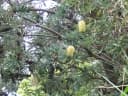
Banksia integrifolia
Banksia integrifolia
Safety & Hazards
None known
Cultivation Details
Banksia integrifolia is a plant of the warm temperate to tropical zones, where it is found at elevations up to 1,700 metres. It grows best in areas where annual daytime temperatures are within the range 18 - 32°c, but can tolerate 10 - 37°c[1]. Mature plants can be killed by temperatures of -10°c or lower, but young growth can be severely damaged at -1°c[1]. It prefers a mean annual rainfall in the range 850 - 1,600mm, but tolerates 650 - 2,000mm[1]. Prefers a sunny position, tolerating some shade[1]. Succeeds in most soils, including moderately saline ones[2, 1]. Requires a lime-free soil[3]. Thrives in acid sandy loams[4]. Prefers a pH in the range 5 - 6.5, tolerating 4.5 - 7[1]. If this species is to be successfully cultivated, the soil should be low in nutrients, especially in nitrates and phosphates[5]. Quite resistant to wind and salt spray, it grows well by the coast[6, 5]. The plant is very tolerant of fire. It has a thick bark that can insulate it from less intense fires and can regrow from epicormic stems produced on the trunk[7]. In addition, the heat of a fire stimulates the seeds to be shed from the 'cone', allowing the seeds to germinate in the newly cleared earth[7]. A polymorphic species, there are many named varieties selected for their ornamental value[5]. A good bee plant[8, 4].
Propagation
Seed - surface sow in an ericaceous compost as soon as the seed is ripe or as soon as it is obtained and do not exclude light. Seal the pot in a plastic bag until germination takes place, which can take 1 - 3 months or more at 20°c[9]. When they are large enough to handle, prick the seedlings out into individual pots and grow them on in the greenhouse for at least their first winter. Plant them out into their permanent positions in late spring or early summer, after the last expected frosts. Cuttings of half-ripe wood, mid summer in sand in a frame[5]. Cite as: Temperate Plants Database, Ken Fern. temperate.theferns.info. 2026-02-20. <temperate.theferns.info/plant/Banksia+integrifolia>
Pollinators
Bees
References
- [1]Ecocrop — http://ecocrop.fao.org/ecocrop/srv/en/home ↩︎Basic information on a wide range of useful plants, plus details of environmental needs where available.
- [2]Australian Native Plants. — Wrigley. J. W. and Fagg. M. · Collins. (Australia) · 1988 · ISBN 0-7322-0021-0 ↩︎A lovely book, written in order to encourage Australian gardeners to grow their native plants. A little bit of information for the plant project.
- [3]RHS Dictionary of Plants plus Supplement. 1956 — F. Chittendon. · Oxford University Press · 1951 · ISBN - ↩︎Comprehensive listing of species and how to grow them. Somewhat outdated, it has been replaced in 1992 by a new dictionary (see [ 200 ]).
- [4]A Field Guide to Australian Trees. — Holliday. I. and Hill. R. · Frederick Muller Ltd. · 1974 · ISBN 0-85179-627-3 ↩︎A well illustrated and very readable book, but it does not contain much information for the plant project.
- [5]The New RHS Dictionary of Gardening. 1992. — Huxley. A. · MacMillan Press · 1992 · ISBN 0-333-47494-5 ↩︎Excellent and very comprehensive, though it contains a number of silly mistakes. Readable yet also very detailed.
- [6]The Milder Garden. — Taylor. J. · Dent · 1990 ↩︎A good book on plants that you didn't know could be grown outdoors in Britain.
- [7]Flora of Australia — http://www.anbg.gov.au/abrs/abif/flora/ ↩︎The full information from the Flora of Australia - on-line. An excellent resource.
- [8]Flora of Victoria. — Ewart. A. J. · University Press; Melbourne · 1930 ↩︎A flora of eastern Australia, it is rather short on information that is useful to the plant project.
- [9]Growing from Seed. Volume 2. — Rice. G. (Editor) · Thompson and Morgan. · 1988 · ISBN - ↩︎Very readable magazine with lots of information on propagation. An interesting article on Ensete ventricosum.
- [10]Wild Food Plants of Australia. — Low. T. · Angus and Robertson. · 1989 · ISBN 0-207-14383-8 ↩︎Well presented, clear information and good photographs. An interesting read for the casual reader as well as the enthusiast
- [11]Dictionary of Economic Plants. — Uphof. J. C. Th. · Weinheim · 1959 · ISBN - ↩︎An excellent and very comprehensive guide but it only gives very short descriptions of the uses without any details of how to utilize the plants. Not for the casual reader.
- [12]The Useful Native Plants of Australia. — Maiden J.H. · Turner & Co.; London. · 1889 · http://www.biodiversitylibrary.org ↩︎Terse details of the uses of many Australian plants and other species naturalised, or at least growing, in Australia. It can be downloaded from the Internet.