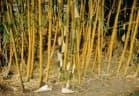
Bambusa tulda
Bambusa tulda
Safety & Hazards
None known
Cultivation Details
Bambusa tulda is a plant of the moist, lowland tropics, where it is found at elevations up to 1,500 metres. It grows best in areas where annual daytime temperatures are within the range 22 - 28°c, but can tolerate 9 - 32°c[1]. It prefers a mean annual rainfall in the range 1,200 - 2,500mm, but tolerates 700 - 4,500mm[1]. Prefers a position in dappled shade, also succeeding in full sun[1]. Grows best in fertile, medium to heavy soils[1]. Prefers a pH in the range 5 - 6, tolerating 4.5 - 6.5[1]. Bamboos have an interesting method of growth. Each plant produces a number of new stems annually - these stems grow to their maximum height in their first year of growth, subsequent growth in the stem being limited to the production of new side branches and leaves. In the case of some mature tropical species the new stem could be as much as 30 metres tall, with daily increases in height of 30cm or more during their peak growth time. This makes them some of the fastest-growing species in the world[PFAF]. About one month after germination a seedling produces its first stem and at this stage the rhizome also starts to develop. After 9 months 4 - 5 young culms have been formed[2]. Shoot growth starts at the beginning of the rainy season and it takes approximately 1 month to emerge above the ground. Height increase of the shoots may attain as much as 70 cm per day[2]. Culms complete their growth within 2 - 3 months after their emergence as shoots, and their diameter and height do not increase as they become older. Young shoots to be used as a vegetable should preferably be harvested while they are still underground. In plantations, selective felling of older culms may start 5 - 7 years after planting. Normally 3 - 4-year-old culms are harvested, retaining at least 3 - 6 evenly spaced culms per clump. A 4-year felling cycle is often adopted. Traditionally, the harvested canes are submerged for 10 - 20 days in running water to improve resistance to powder-post beetles. Subsequently the culms are air dried for 1.5 - 3.5 months. The culms suffer considerably from cracking and collapse. Cracks often extend along the entire length of the internodes and the culm collapses at these cracks. To improve their durability, culms can be treated with solutions of sodium carbonate, calcium hydroxide or copper sulphate[2]. The annual yield of dry culms is about 3 tonnes/ha in India[2]. Bamboos in general are usually monocarpic, living for many years before flowering, then flowering and seeding profusely for a period of 1 - 3 years before usually dying. Bengal bamboo normally flowers gregariously for a period of 2 years in a cycle of 25 - 40 years, and produces viable seed[2]. However, it also often flowers sporadically or in small groups, without an obvious cycle[2]. In Bangladesh several forms are distinguished: 'tulda bans' is the normal form; 'jowa bans' is a large form with longer and thicker culms, mainly used for scaffolding and construction; and 'basini bans' is a form with a larger cavity in the culms and is mainly used for basketry[2].
Propagation
Seed - under ambient conditions, the seed remains viable for about 1 month only; when stored dry (in a desiccator over silica gel) viability can be extended to up to 1.5 years[2]. Surface sow the seed in containers as soon as it is ripe, preferably at a temperature around 20°c. Do not allow the compost to dry out. Germination of around 70%[2] usually takes place fairly quickly so long as the seed is of good quality, though it can take 3 - 6 months. Prick out the seedlings into containers when they are large enough to handle and grow on in a lightly shaded place until large enough to plant out. Plants only flower at intervals of many years and so seed is rarely available. Division as new growth commences[3]. Take divisions with at least three canes in the clump, trying to cause as little root disturbance to the main plant as possible. Grow them on in light shade in pots of a high fertility sandy medium. Mist the foliage regularly until plants are established. Plant them out into their permanent positions when a good root system has developed, which can take a year or more[4]. Propagation by rhizome cuttings with direct planting in the field is very successful (survival more than 90%) and average height of shoots 2.5 months after planting is 1.35 m. Rhizome parts can best be taken at the beginning of the rainy season from 1 - 2-year-old culms and planted in pits of 60 cm3 at a spacing of 8 m x 8 m[2]. Cite as: Tropical Plants Database, Ken Fern. tropical.theferns.info. 2026-02-19. <tropical.theferns.info/viewtropical.php?id=Bambusa+tulda>
Pollinators
Data unavailable
References
- [1]Ecocrop — http://ecocrop.fao.org/ecocrop/srv/en/home ↩︎Basic information on a wide range of useful plants, plus details of environmental needs where available.
- [2]Plant Resources of Southeast Asia — http://proseanet.org/ ↩︎Lots of information on the uses of the plants of SE Asia.
- [3]Bamboos of Nepal — Stapleton. C. · The Royal Botanic Gardens, Kew · 1994 · ISBN 0947643680 ↩︎An excelllent little booklet that looks in some detail at the native bamboos of Nepal, including looking at their uses.
- [4]The New RHS Dictionary of Gardening. 1992. — Huxley. A. · MacMillan Press · 1992 · ISBN 0-333-47494-5 ↩︎Excellent and very comprehensive, though it contains a number of silly mistakes. Readable yet also very detailed.
- [5]Plants and People of Nepal — Manandhar. N. P. · Timber Press. Oregon. · 2002 · ISBN 0-88192-527-6 ↩︎Excellent book, covering over 1,500 species of useful plants from Nepal together with information on the geography and peoples of Nepal. Good descriptions of the plants with terse notes on their uses.
- [PFAF]Plants for a Future — pfaf.org ↩︎