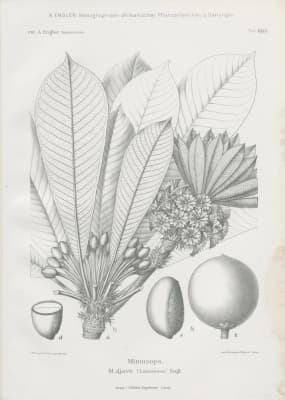
Cultivation Details
The tree occurs in primary rain forest in humid and warm climates, with a mean annual temperature of 23 - 26°c and a mean annual rainfall of 1,500 - 3,000 mm[1]. Seeds germinate in abundance under or close to mother trees. However, young plants of 1 metre tall are rare as a result of predation by animals, mainly elephants, and the survival rate of seedlings after 18 months is practically nil under the mother tree and very low (less than 2%) elsewhere[1]. In forest undergrowth seedlings grow 4 - 5 cm/year. They respond rapidly to the opening of the forest cover and direct sunlight, and under these circumstances may grow up to 40 cm/year. When the tree bole has attained 1 metre in diameter and the crowns have reached or passed the forest canopy, diameter growth is up to 9.5 mm/year. It has been estimated from growth rings and C14 dating that a tree with a bole diameter of 1 metre was 260 years old and one with a diameter of 2.8 metres 600 - 700 years[1]. The tree starts flowering at an age of 50 - 70 years, when it has reached the light in the upper storey of the forest, but regular fructification starts still later, when the bole has reached 70 cm in diameter[1]. Fruits are produced annually, but mass production occurs once in 3 years. About 6,000 seeds per tree are produced within a cycle of 3 years; a single tree produced 2,460 kg of fruits, including 327 kg of seed kernels[1]. The fruiting season lasts up to 4 weeks for an individual tree, but may last 3 months for a whole wild population[1]. At present, the only management measure for natural forest is the maintenance of a minimum diameter limit for exploitation, i.e. 70 cm in Gabon, 80 cm in Congo and 100 cm in Cameroon. In Cameroon commercial exploitation of the tree implies the cutting of 90% of trees above 100 cm in diameter, leaving only poorly shaped trees. It has been estimated that after 300 years 84% of the harvested volume is re-established and after 500 years 92%. Sustainable production in natural forest is therefore not possible. Cutting cycles of 30 years, as often practised, threaten the populations seriously[1]. During the fruiting season, local people often move to localities where clusters of trees are found and stay there in temporary camps for 2 - 8 weeks. The collected fruits are depulped and the seed kernels dried. After heating, the oil is gathered by pressing with a traditional wooden press. The oil is used domestically or sold. It can be stored for 1 - 2 years[1]. In 1992, which was a very good year for fruit production, the yield of oil was estimated at 135 - 165 litres per adult tree[1].
Propagation
Seed. Shade is required for germination, which usually takes 1 - 4 weeks[1]. The germination capacity of fresh seeds is high (> 85%), but drops rapidly to 5% after 6 weeks of storage due to rapid degradation of the fatty acids[1]. However, fresh seeds stored at 4°C and humid conditions still showed a germination rate of about 50% after 11 months[1]. In the nursery the lower half of the seed is buried, with the scar pointing downwards. The mortality of seedlings in the nursery is very low. Partial shading is favourable for seedling development. Under optimal nursery conditions seedlings may reach 35 cm in height after 6 weeks, 45 cm after 3 months and 1.5 metres after 18 months[1]. The seedling develops a taproot and so it is recommended to sow into polythene pots. Seedlings are planted out into the field, when about 4 - 5 months old, at the start of the rainy season under the light shade of about 10 retained adult trees per ha. The shade should be removed gradually when a reduction in diameter growth is observed[1]. Seeds germinate in abundance under or close to mother trees - whilst it is not necessary for the seeds to pass through the intestines for germination, it does accelerate germination slightly[1]. Cite as: Tropical Plants Database, Ken Fern. tropical.theferns.info. 2026-02-19. <tropical.theferns.info/viewtropical.php?id=Baillonella+toxisperma>
Pollinators
Data unavailable
References
- [1]Protabase - Plant Resources of Tropical Africa. — http://www.prota.org ↩︎An excellent on-line database with detailed information on over 3,200 species of useful plants of Africa.
- [2]Tropix 7 — CIRAD · http://tropix.cirad.fr/en ↩︎An on-line guide to the timbers of 245 species of trees.
- [3]Mansfeld's Database of Agricultural and Horticultural Plants — http://mansfeld.ipk-gatersleben.de/pls/htmldb_pgrc/f?p=185:3:4292127278597336 ↩︎Terse details of a huge range of useful plants.