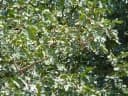
Baikiaea plurijuga
Baikiaea plurijuga
Safety & Hazards
None known
Cultivation Details
A plant of moderate elevations in the drier regions of the tropics, where it is mainly found at elevations between 900 - 1,200 metres[1, 2]. Mature trees can withstand extreme temperatures of over 40°c and have been known to survive severe frost down to -15°c[2]. Plants are frost sensitive[3]. It is found in areas with a mean annual rainfall of 600 - 1,000mm and a dry season of 6 - 8 months[2]. Prefers a sunny position[3]. Grows in the wild in deep, infertile, sandy soils[2]. Grows best in a well-drained, light to medium soil[3]. Established plants have a deep tap root and are very drought resistant[2]. Prefers a pH in the range 5 - 5.5, tolerating 4.5 - 6.5[3]. Coppices well[4]. The plant suffers adversely from fires in the dry season, and cannot afterwards compete with fast-growing, thorny, colonizer bushes[3]. Although many species within the family Fabaceae have a symbiotic relationship with soil bacteria, this species is said to be devoid of such a relationship and therefore does not fix atmospheric nitrogen[5].
Propagation
Seed - it can be stored for at least 12 months at room temperature[2]. Freshly harvested seeds can germinate without pre-treatment, but after drying it may be necessary to scarify the hard seed coat[2]. The recommended pre-treatment is to soak the seeds in hot water for 2 minutes at 80°c, followed by soaking in cold water for 24 hours[2]. The seeds are sown directly into deep containers at a sowing depth of 4 - 5 cm. Seed viability is high and 80 - 90% of them germinate within 7 - 25 days[2]. However, it is difficult to raise seedlings of this species in the nursery because of the long taproot. Just one or two weeks after germination, the tap root will grow below the base of a normal-sized open container and, after 6 months, the seedlings are still only 6 - 7 cm tall but the taproot will have grown 40cm long[2]. Cite as: Tropical Plants Database, Ken Fern. tropical.theferns.info. 2026-02-19. <tropical.theferns.info/viewtropical.php?id=Baikiaea+plurijuga>
Pollinators
Insects
References
- [1]Flora Zambesiaca — http://apps.kew.org/efloras/fz/intro.html ↩︎An excellent online flora of plants from the Zambezi River basin. It lists a number of the plant uses as well as the habitats and botanical descriptions of the plants.
- [2]Seed Leaflets — Various · Forest & Landscape. Denmark · http://en.sl.life.ku.dk/Publikationer/Udgivelser/PopulaerPublikationer.aspx?katid={D28373CC-6EF3-4EF8-B097-6D83FABF209E}&serieid={9F1C3DB1-6E7B-4CF1-AF53-F480B0CB40EF}&sort=title ↩︎A series of leaflets, jointly produced by the University of Copenhagen and the Royal Botanic Gardens at Kew, focussing on seed information for a number species, but also giving a lot of other information about each plant.
- [3]Ecocrop — http://ecocrop.fao.org/ecocrop/srv/en/home ↩︎Basic information on a wide range of useful plants, plus details of environmental needs where available.
- [4]Global Tree Campaign - 40 Species in Trade — http://www.unep-wcmc.org/trees/trade/40_species_in_trade.htm ↩︎Information on the habitats, uses and some cultivation notes for 40 species of timber trees.
- [5]Nodulation Plants in GRIN Taxonomy — United States Department of Agriculture · http://www.ars-grin.gov/~sbmljw/cgi-bin/taxnodul.pl?language=en ↩︎An online database listing plants that have either positive or negative reports on root and stem nodulation with nitrogen-fixing bacteria.
- [6]African Flowering Plants Database — Conservatoire et Jardin Botaniques. · http://www.ville-ge.ch/musinfo/bd/cjb/africa/recherche.php ↩︎Contains information on over 150,000 plant names (including synonyms) giving a description and habitat, plus a distribution map.
- [7]Gemsbok Bean and Kalahari Truffle — Leffers A. · Gamsberg MacMillan; Namibia. · 2003 · ISBN 99916-0-491-X ↩︎Details of the traditional uses of over 200 species of plants in northeastern Namibia. Written for the non-expert, there is usually at least one photograph with each plant entry.
- [8]Tropical Timbers of the World. Ag. Handbook No. 607. — Chudnoff. Martin. · USDA Forest Service. Wisconsin. · 1984 ↩︎Terse details on the properties of the wood of almost 400 species of trees from the Tropics.