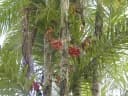
Bactris gasipaes
Bactris gasipaes
Safety & Hazards
The stems are usually heavily armed with rings of very sharp, black spines about 5 cm long[1].
Cultivation Details
Plants succeed in moist tropical climates with heavy rainfall and poor soils[2]. They grow in lowland areas below 800 metres, where temperatures never fall below 10°c, the average annual rainfall is 1,500mm or more and the driest month has 25mm or more rain[3, 2]. They can withstand relatively hot dry seasons of 3 - 4 months[2]. Requires a fertile, moist, but well-drained soil, a humid atmosphere and some protection from strong sun[4]. Seedlings develop very slowly under forest shade conditions, and mature plants require full sunlight for optimal production of flowers, fruits and offshoots[2]. Plants are most productive when grown on relatively deep, fertile, well-drained soils, clay soils, and highly eroded laterites with 50% aluminium-saturated, acid soils[2]. Prefers a pH in the range 5 - 6.5, tolerating 4 - 7.5[5]. The spiny stem of the tree grows rapidly in height, attaining 15 - 20 metres in just 10 years[2]. Plants begin flowering when 3 - 5 years old, and can produce two fruit crops a year for the next 50 - 75 years[2, 5]. Fruit yields may be as high as 10 - 30 tonnes/ha, but are often only about 2 - 3 tonnes/ha[5]. Yields of 50 - 100 kilos per trunk per year are not unusual[5]. For palm hearts the yield ranges from 4,000 - 10,000 hearts/ha per year[5]. Plants sometimes produce just a solitary trunk, at other times they can have several trunks[3]. Plants produce rings of needle-like spines 5cm long[6]. This can make harvesting the fruit and buds rather unpleasant. There is at least one named form, called 'Spineless', that is entirely free of these spines[6]. There are other forms that have seedless fruits[7, 8]. A shallow-rooted plant[5].
Propagation
Seed - pre-soak for 24 hours in warm water and sow in containers. Germination takes 2 months or more[3]. The seed has a limited viability and needs to be sown as fresh as possible[3]. Seedlings require about 6 - 9 months in the nursery; planting out should be done when the soil is humid and the potential evapotranspiration rate is low[2]. Seeds are recalcitrant. They rapidly lose viability when dried and should not be exposed to direct sunlight during germination[2]. Fresh seed has 45-50% mc, and if this falls below 38-40%, germination is reduced[2]. Seed is rarely formed in this species[3]. Division of suckers from a mature palm after it has produced four stems[1]. Suckers should have produced roots and be 7 to 8 cm in diameter at the base and 1 to 1. 5 metres high[1]. Cite as: Tropical Plants Database, Ken Fern. tropical.theferns.info. 2026-02-19. <tropical.theferns.info/viewtropical.php?id=Bactris+gasipaes>
Pollinators
Insects, Wind
References
- [1]Palm and Cycad Societies of Australia. — http://www.pacsoa.org.au/ ↩︎Contains at least a little information on the majority of palm and cycad species, plus a wealth of photographs. A first class website.
- [2]World Agroforesty Centre — http://www.worldagroforestry.org/ ↩︎An excellent online database of a huge range of trees giving very good information on each plant - its uses, ecology, identity, propagation, pests etc.
- [3]Palms of the World — Blombery. A. & Rodd. T. · Angus and Robertson · 1992 · ISBN 0-207-14848-1 ↩︎An excellent guide, well illustrated, with information on cultivation, uses, habitat etc of almost 200 species of Palms.
- [4]The New RHS Dictionary of Gardening. 1992. — Huxley. A. · MacMillan Press · 1992 · ISBN 0-333-47494-5 ↩︎Excellent and very comprehensive, though it contains a number of silly mistakes. Readable yet also very detailed.
- [5]Ecocrop — http://ecocrop.fao.org/ecocrop/srv/en/home ↩︎Basic information on a wide range of useful plants, plus details of environmental needs where available.
- [6]Cornucopia II — Facciola. S. · Kampong Publications, California. · 1998 · ISBN 0-9628087-2-5 ↩︎The second edition of an excellent guide to the edible uses of plants, though it does not give any details of cultivation etc.
- [7]Dictionary of Economic Plants. — Uphof. J. C. Th. · Weinheim · 1959 · ISBN - ↩︎An excellent and very comprehensive guide but it only gives very short descriptions of the uses without any details of how to utilize the plants. Not for the casual reader.
- [8]Field Guide to the Palms of the Americas — Henderson A.; Galeano G.; Bernal R. · Princeton University Press; Princeton, New Jersey. · 1995 · ISBN 0-691-08537-4 ↩︎An excellent book, giving basic information on all the 550 species of palms native to the Americas that were known in 1995. Comprehensive information on the plants range and habitat, brief description, some uses and almost 250 photos.
- [9]Plant Resources of Southeast Asia — http://proseanet.org/ ↩︎Lots of information on the uses of the plants of SE Asia.
- [10]Flora of Barro Colorado Island — Croat. Thomas B. · Stanford University Press · 1978 · http://biogeodb.stri.si.edu/bioinformatics/croat/home · ISBN 0-8047-0950-5 ↩︎A very good flora of an area in Panama. Written some years ago, so some of the names have been changed. The book is out of print, but the whole flora is now available on the web.
- [11]Vegetables in the Tropics — Tindall. H. D. · MacMillan, Oxford. · 1983 · ISBN 0-333-24268-8 ↩︎An excellent, in-depth look at the main vegetable crops that can be grown in the Tropics, plus many less well-known plants.
- [12]Edible Nuts. — Wickens G.E. · FAO, Rome. · 1995 · http://www.fao.org/docrep/ · ISBN 92-5-103748-5 ↩︎Detailed information on 20 of the most valuable nut crops, plus more basic information on a wide range of other nut-producing plants. It can be downloaded from the Internet.
- [13]Heart of Palm Use: A Family Survey — Scott Zona, Ph.D. · Fairchild Tropical Botanic Garden, Virtual Herbarium. · http://www.virtualherbarium.org/palmresearch/Hearts_of_Palm_table.html ↩︎An on-line article listing the botanical names and range of palm trees that have an edible apical bud.
- [14]Medicinal Plants of Brazil — Mors W.B.; Rizzini C.T.; Pereira N.A. · Reference Publications; Michigan. · 2000 · ISBN 0-917256-42-5 ↩︎An extremely concise book, listing approximately 1,500 species and varieties of plants with their botanical name, common name in Brazil, regions in Brazil where the plant is found, a brief list of uses and any medically active compounds in the plant.
- [PFAF]Plants for a Future — pfaf.org ↩︎