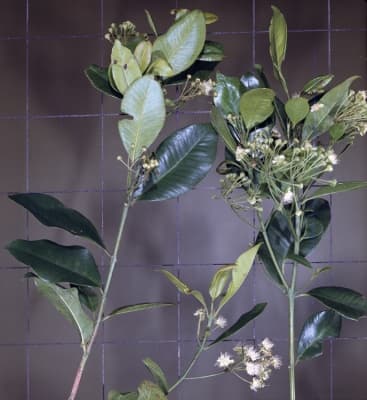
Backhousia hughesii
Backhousia hughesii
Safety & Hazards
None known
Cultivation Details
Backhousia hughesii is a plant of lowland to lower montane rainforests in northeast Australia. Species in this genus generally prefer a moist but well-drained fertile soil and a position in full sun[1]. Trees of this species when wounded produce an exudate which hardens to form a grey stony mass. Hence the name Stonewood. These stones can be produced inside the tree and were the subject of numerous profane comments from timber cutters who encountered them with a freshly sharpened chain saw[2].
Propagation
Seed - it is difficult to germinate[3]. Surface sow onto a moist medium, standing the seed tray in almost half its depth of clean water and maintain a temperature around 16 - 18c[1]. Seedlings take about 12 months to develop fully. When seedlings are about 5mm tall, remove the tray from the water, leave for 4 - 5 days and then prick the seedlings out into individual containers[1]. Cuttings of semi-ripe wood with a heel[1]. Slow to make roots[3]. Small lower branches often touch the ground and form roots. These can be severed from the parent plant, and planted elsewhere[4]. Cite as: Tropical Plants Database, Ken Fern. tropical.theferns.info. 2026-02-19. <tropical.theferns.info/viewtropical.php?id=Backhousia+hughesii>
Pollinators
Insects
References
- [1]The New RHS Dictionary of Gardening. 1992. — Huxley. A. · MacMillan Press · 1992 · ISBN 0-333-47494-5 ↩︎Excellent and very comprehensive, though it contains a number of silly mistakes. Readable yet also very detailed.
- [2]Australian Tropical Rainforest Plants — http://www.anbg.gov.au/cpbr/cd-keys/rfk/index.html ↩︎An online resource giving botanical information, and a little bit about plant usage, for over 2,700 species of plants found in the Australian rainforest.
- [3]Australian Native Plants Society — http://anpsa.org.au/index.html ↩︎A series of fact sheets on Australian plants. Good photographs, brief description and information on uses, habitat, range, cultivation etc.
- [4]Growing Native Plants — Australian National Botanic Gardens · http://www.anbg.gov.au/gnp/ ↩︎A series of articles giving details of cultivation and matters of general interest (including a few plant uses) on over 250 Australian plants.