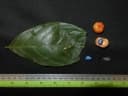
Baccaurea racemosa
Baccaurea racemosa
Safety & Hazards
None known
Cultivation Details
A plant of the lowland tropic al forest, where it is found at elevations up to 1,000 metres. It grows best in areas where annual daytime temperatures are within the range 21 - 28°c, but can tolerate 14 - 34°c[1]. It prefers a mean annual rainfall of around 2,500mm, but tolerates 1,500 - 4,500mm[1]. Prefers a sunny position, succeeding in light shade[1]. Succeeds on a range of soils[2]. Found in the wild on granite to yellow or red sandy clay soils[3]. Prefers a pH in the range 5 - 5.5, tolerating 4.5 - 6[1]. Plants can fruit all year round[3]. A dioecious species, both male and female forms need to be grown if fruit and seed are required[3].
Propagation
Seed - when sown fresh it usually germinates in a few days[4]. Cite as: Tropical Plants Database, Ken Fern. tropical.theferns.info. 2026-02-19. <tropical.theferns.info/viewtropical.php?id=Baccaurea+racemosa>
Pollinators
Data unavailable
References
- [1]Ecocrop — http://ecocrop.fao.org/ecocrop/srv/en/home ↩︎Basic information on a wide range of useful plants, plus details of environmental needs where available.
- [2]Trees Commonly Cultivated in SE Asia — Jensen. M. · FAO Regional Office, Bangkok. · 1999 · ISBN 974-89377-5-5 ↩︎
- [3]Euphorbiaceae of Malesia — http://www.nationaalherbarium.nl/euphorbs/ ↩︎An online resource that is still being developed, it gives detailed botanical descriptions of plants in the family Euphorbiaceae found growing in Malesia (the region from Peninsual Malaysia through Indonesia, the Philippines).
- [4]Plant Resources of Southeast Asia — http://proseanet.org/ ↩︎Lots of information on the uses of the plants of SE Asia.
- [5]Mansfeld's Database of Agricultural and Horticultural Plants — http://mansfeld.ipk-gatersleben.de/pls/htmldb_pgrc/f?p=185:3:4292127278597336 ↩︎Terse details of a huge range of useful plants.
- [6]Dictionary of Economic Plants. — Uphof. J. C. Th. · Weinheim · 1959 · ISBN - ↩︎An excellent and very comprehensive guide but it only gives very short descriptions of the uses without any details of how to utilize the plants. Not for the casual reader.
- [PFAF]Plants for a Future — pfaf.org ↩︎