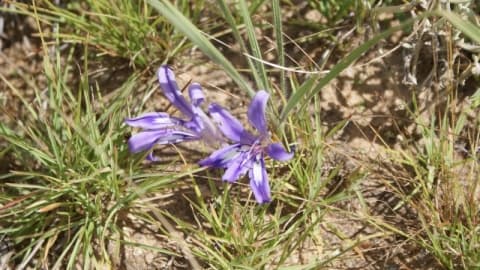
Babiana hypogea
Babiana hypogea
Safety & Hazards
None known
Cultivation Details
Babiana hypogea grows in semi-arid areas on the edge of the summer rainfall areas of southwest Africa. Its growth habit responds at least in part to rainfall timing, with some plants flowering in summer when the occasional good summer rains fall, rather than in the more usual dry late winter and spring[1]. Outside its native habitat, plants can be grown in regions where winter temperatures do not fall much below -5°c, or they can be grown outdoors through the summer, lifting the corms in autumn and storing them for replanting the following spring[2]. Requires a sunny position in a light, rich, freely-draining soil[2]. The corms should be planted 20 - 25cm deep[2]. The flowers are scented[2].
Propagation
Seed - usually germinates within 4 - 8 weeks at 20°c[3]. Give young seedlings as much light as possible[3]. Sow the seed thinly so that it does not need to be thinned and grow the young plants on for their first year without disturbance. Give an occasional liquid feed to ensure that they do not become nutrient deficient. Pot the small bulbs up when they are dormant, placing 2 - 3 bulbs in each pot, and grow them on until large enough to plant out - preferably when dormant. Cite as: Temperate Plants Database, Ken Fern. temperate.theferns.info. 2026-02-20. <temperate.theferns.info/plant/Babiana+hypogea>
Pollinators
Bees
References
- [1]A revision of the southern African genus Babiana, Iridaceae: Crocoideae — Goldblatt P. & Manning J.C. · South African National Biodiversity Institute: Pretoria · 2007 · ISBN 978-1-919976-32-7 ↩︎An in-depth revision of the genus Babiana
- [2]The New RHS Dictionary of Gardening. 1992. — Huxley. A. · MacMillan Press · 1992 · ISBN 0-333-47494-5 ↩︎Excellent and very comprehensive, though it contains a number of silly mistakes. Readable yet also very detailed.
- [3]Growing from Seed. Volume 2. — Rice. G. (Editor) · Thompson and Morgan. · 1988 · ISBN - ↩︎Very readable magazine with lots of information on propagation. An interesting article on Ensete ventricosum.
- [4]Flora Zambesiaca — http://apps.kew.org/efloras/fz/intro.html ↩︎An excellent online flora of plants from the Zambezi River basin. It lists a number of the plant uses as well as the habitats and botanical descriptions of the plants.