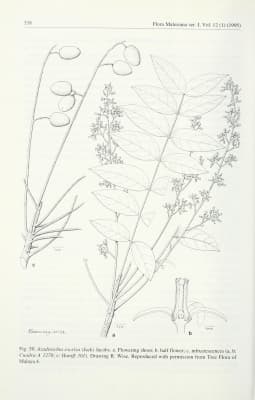
Azadirachta excelsa
Azadirachta excelsa
Safety & Hazards
None known
Cultivation Details
A plant of lowland monsoonal areas in the tropics, where it grows at elevations up to 350 metres[1]. It is found in areas where the mean annual rainfall is in the range 2,000 - 4,000mm, and the mean annual temperature is 22 - 27°c[1]. Prefers alluvial, medium textured, free draining, acidic soils. It is also found growing on clay soils, granite soils; lateritic soils and limestone[1]. Prefers a pH in the range 5 - 6.5[2]. Plants are intolerant of waterlogging or frequent flooding[3]. Trees commence flowering and fruiting when about 6 - 7 years old[3]. Normally the trees are harvested when about 15 years old, when they are about 20 to 30 metres tall, with clear boles 6 - 10 metres tall and 34 - 45cm in diameter[3]. On very fertile sites, the trees can reach these dimensions in 8 - 10 years[3]. No large scale plantation trials have been attempted in Peninsular Malaysia, but there are a number of small experimental trials. The species has gained in importance as a plantation species due to its fast growth and good timber[1]. However, its unknown genetic base could be a major constraint to the large-scale establishment of plantations[1]. The species survives well with almost 100% survival in the field and is relatively free from pest and disease problems during the early growth phase. Growth is slow initially but subsequently increases significantly. In plantations, it is planted at a spacing of 2 - 4 metres x 4 metres. Harvest of sentang is usually 5 years after planting[1]. Thinning should be done to promote rapid growth and maintain wind firmness[1]. Pruning is generally unnecessary, as the tree will self-prune (lower older branches will naturally die and break off)[1]. This species is closely related to A. Indica (which has a more westerly distribution), and hybridizes with it in the wild where their ranges overlap[2].
Propagation
Seed - the germination rate is 75 - 80% when the seeds are sown directly after harvesting[1]. Stored seed quickly loses its viability[3]. The seeds germinate in 6 - 23 days[3]. Direct dibbling of seeds into a prepared container to the same depth as the seed dimension (about 1 cm deep) and covering with soil is the recommended sowing method[3]. Seeds may also be broadcast into seedbeds at scattered spacing, covered with a thin layer of soil up to 1cm deep[3]. When seedlings reach 30 - 40 cm tall (usually in 3 or 4 months), they are ready for outplanting[3]. The species also can be propagated vegetatively by rooting cuttings using juvenile seedlings or rejuvenile materials from root reservoirs[3]. Spacing in seedbeds is 20 cm between rows and 5 cm within rows. After germination the seedlings require at least 50% shade initially and are gradually exposed to full sunlight when about 30 cm tall. Seedlings can be transferred into large polypots (5 x 8 cm) when two pairs of leaves have developed. In Thailand the recommended potting medium is a mixture of coconut husk and topsoil at a 3:1 ratio, incorporated with a controlled-release fertiliser such as Osmocote at 0.5 g per pot, which is about enough for 3 months or until seedlings are ready for planting out[2]. Seedlings are normally ready for planting out after 6 months. At least one month before planting out, all seedlings need hardening-off by reducing the water regime and exposing seedlings to full sunlight[2]. Root cuttings are possible for industrial scale A. Excelsa establishment. This is the best way to guarantee an adequate supply of clonal material from desirable donor trees. Over 90% rooting rates have been obtained when cuttings are taken from coppicing shoots[1]. Rootlets 0.3 - 0.5 cm diameter and 3 - 5 cm long have been used successfully as propagules[1]. Tissue culture for mass propagation has not been demonstrated to be viable for large-scale seedling production[1]. Cite as: Tropical Plants Database, Ken Fern. tropical.theferns.info. 2026-02-19. <tropical.theferns.info/viewtropical.php?id=Azadirachta+excelsa>
Pollinators
Data unavailable
References
- [1]World Agroforesty Centre — http://www.worldagroforestry.org/ ↩︎An excellent online database of a huge range of trees giving very good information on each plant - its uses, ecology, identity, propagation, pests etc.
- [2]Seed Leaflets — Various · Forest & Landscape. Denmark · http://en.sl.life.ku.dk/Publikationer/Udgivelser/PopulaerPublikationer.aspx?katid={D28373CC-6EF3-4EF8-B097-6D83FABF209E}&serieid={9F1C3DB1-6E7B-4CF1-AF53-F480B0CB40EF}&sort=title ↩︎A series of leaflets, jointly produced by the University of Copenhagen and the Royal Botanic Gardens at Kew, focussing on seed information for a number species, but also giving a lot of other information about each plant.
- [3]Tropical Tree Seed Manual — Vosso. J. Editor. · USDA Forest Service. · 2002 · http://www.rngr.net/Publications/ttsm ↩︎An extremely good guide, it can also be downloaded in its entirety from the address shown above.
- [4]Timber Notes - Light Hardwoods VII (Sentang, Sepetir, Sesendok, Terap, Terentang) — Gan K. S.; Choo K. T.; Lim S. C. · Timber Technology Centre, FRIM; Kuala Lumpur. · 1999 · https://info.frim.gov.my/infocenter/booksonline/ttb/TTBno17.pdf · ISBN 139-258 ↩︎An excellent series of leaflets, this one gives information on the wood of several species of light hardwoods. It can be downloaded as a PDF document from the Internet.