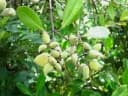
Avicennia officinalis
Avicennia officinalis
Safety & Hazards
None known
Cultivation Details
A plant of the moist to wet tropics and subtropics, where it is always found at around sea-level near the coast. It grows best in areas where annual daytime temperatures are within the range 25 - 34°c, but can tolerate 15 - 38°c[1]. It can be killed by temperatures of -1°c or lower[1]. It prefers a mean annual rainfall in the range 1,000 - 3,000mm, but tolerates 800 - 4,000mm[1]. A plant of the coastal marshes, needing to grow in this habitat if it is to thrive. It requires a sunny position[1]. Plants succeed in alkaline and saline conditions[2]. Succeeds with a pH in the range 6 - 8.5[2]. Prefers a pH in the range 6.5 - 7, tolerating 6 - 7.5[1]. Planting of this species is usually not needed because natural regeneration is so successful. In Avicennia and Rhizophora direct seeding result in ca 90% survival[2]. Since this mangrove can regrow rapidly from buds beneath the bark along the trunk and branches, it is said to suffer little from removal of much of the branchwood[2]. Good mangrove stands can show annual productivity of 10 - 20 (-25) metric tonnes per hectare per year[3]. Because of the heaviness of the wood, a cubic meter of mangrove is generally more valuable than other species[2]. Litter fall may account for 1/3 - 1/2 of aboveground productivity[2].
Propagation
Seed - there is no dormancy, but the seeds are normally sown with the fruit cover removed, because it is highly susceptible to fungus attack[4]. Fresh seeds often have very high germination, typically more than 95%[4]. Seed that has imbibed moisture will usually have radicle formation within 3 days from sowing[4]. Division of root suckers[4]. Cite as: Tropical Plants Database, Ken Fern. tropical.theferns.info. 2026-02-19. <tropical.theferns.info/viewtropical.php?id=Avicennia+officinalis>
Pollinators
Data unavailable
References
- [1]Ecocrop — http://ecocrop.fao.org/ecocrop/srv/en/home ↩︎Basic information on a wide range of useful plants, plus details of environmental needs where available.
- [2]Handbook of Energy Crops — Duke. J. · - · 1983 · https://hort.purdue.edu/newcrop/duke_energy/dukeindex.html · ISBN - ↩︎Published only on the Internet, excellent information on a wide range of both temperate and tropical plants.
- [3]Comfrey Report. — Hills. L. · Henry Doubleday Research Ass. ↩︎A small booklet giving a fairly comprehensive guide to the uses of comfrey.
- [4]Seed Leaflets — Various · Forest & Landscape. Denmark · http://en.sl.life.ku.dk/Publikationer/Udgivelser/PopulaerPublikationer.aspx?katid={D28373CC-6EF3-4EF8-B097-6D83FABF209E}&serieid={9F1C3DB1-6E7B-4CF1-AF53-F480B0CB40EF}&sort=title ↩︎A series of leaflets, jointly produced by the University of Copenhagen and the Royal Botanic Gardens at Kew, focussing on seed information for a number species, but also giving a lot of other information about each plant.
- [5]IUCN Red List of Threatened Species — http://www.iucnredlist.org/ ↩︎A list of plants under threat and facing possible extinction, usually with brief details of the threats and information on habitat.
- [6]Flora of China — Missouri Botanical Garden Press; St. Louis. · 1994 · http://flora.huh.harvard.edu/china/ ↩︎An excellent, comprehensive resource in 25 volumes. In addition to the botanical information the flora also gives basic information on habitat and some uses. An on-line version is also available.
- [7]Dictionary of Economic Plants. — Uphof. J. C. Th. · Weinheim · 1959 · ISBN - ↩︎An excellent and very comprehensive guide but it only gives very short descriptions of the uses without any details of how to utilize the plants. Not for the casual reader.