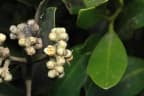
Avicennia marina
Avicennia marina
Safety & Hazards
The young seed leaves may contain toxic compounds[1].
Cultivation Details
A plant of tropical and subtropical coastal areas, where it is found at elevations up to 50 metres. It grows best in areas where annual daytime temperatures are within the range 20 - 34°c, but can tolerate 8 - 39°c[2]. It can be killed by temperatures of -1°c or lower[2]. It prefers a mean annual rainfall in the range 1,500 - 2,500mm, but tolerates 1,000 - 4,000mm[2]. The plant can also tolerate drier areas with an annual rainfall as low as 200mm[1]. Requires a sunny position[1, 2]. Plants have a wide physiological tolerance to salinity, being able to survive in fresh stagnant water as well as in seasonally dry conditions with very high salinity[1]. They tolerate soils with a pH in the range of 6 to 8.5[1]. Prefers a pH in the range 6.5 - 7, tolerating 6 - 7.5[2]. Very tolerant of heavy metals in the soil[1]. Trees suffer little from removal of branchwood because they can resprout rapidly from buds along the stems[1]. Honey bees collect nectar from the flowers[1]. The seeds start germinating while still attached to the tree, but the embryo stays within the fruit until fruit fall. Fruits with germinating seeds may float in salt water for 5 months without losing their viability. Most of these strand within 1 km of the mother tree, and very few were observed to disperse more than 10 km[1]. In many mangrove regions, the potential of Avicennia marina is considered limited and other mangrove species such as Rhizophora spp. Are often more highly valued for timber, firewood, charcoal, dye and tannin production. Although mangroves are often heavily exploited, Avicennia marina is often left[1].
Propagation
Seed - best sown as soon as ripe[1]. The seeds are very susceptible to desiccation. There is also progressive deterioration of the internal tissues of the seeds associated with fungal infection during hydrated storage. Young seedlings grow best when they are in contact with fresh water, but growth diminishes soon under these conditions and is best in water with 10 - 50% of full seawater salinity for older seedlings[1]. Natural regeneration is often abundant, and wildlings can be collected to serve as planting stock[1]. Propagation by air layering and root suckers has been successful[1]. Cite as: Tropical Plants Database, Ken Fern. tropical.theferns.info. 2026-02-19. <tropical.theferns.info/viewtropical.php?id=Avicennia+marina>
Pollinators
Insects
References
- [1]Protabase - Plant Resources of Tropical Africa. — http://www.prota.org ↩︎An excellent on-line database with detailed information on over 3,200 species of useful plants of Africa.
- [2]Ecocrop — http://ecocrop.fao.org/ecocrop/srv/en/home ↩︎Basic information on a wide range of useful plants, plus details of environmental needs where available.
- [3]IUCN Red List of Threatened Species — http://www.iucnredlist.org/ ↩︎A list of plants under threat and facing possible extinction, usually with brief details of the threats and information on habitat.
- [4]Flora Zambesiaca — http://apps.kew.org/efloras/fz/intro.html ↩︎An excellent online flora of plants from the Zambezi River basin. It lists a number of the plant uses as well as the habitats and botanical descriptions of the plants.
- [5]Screening of some indigenous Qatari medicinal plants for antimicrobial activity — Adel M Mahasneh · 2002 · https://doi.org/10.1002/ptr.1037 ↩︎
- [6]Dictionary of Economic Plants. — Uphof. J. C. Th. · Weinheim · 1959 · ISBN - ↩︎An excellent and very comprehensive guide but it only gives very short descriptions of the uses without any details of how to utilize the plants. Not for the casual reader.