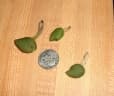
Avicennia germinans
Avicennia germinans
Safety & Hazards
None known
Cultivation Details
A plant of coastal areas in the tropics, where it is found at elevations up to 50 metres. It grows best in areas where annual daytime temperatures are within the range 20 - 30°c, but can tolerate 10 - 35°c[1]. It can be killed by temperatures of -1°c or lower[1]. It prefers a mean annual rainfall in the range 1,500 - 2,500mm, but tolerates 1,000 - 4,000mm[1]. Requires a sunny position[1]. Plants have a wide physiological tolerance to salinity, being able to survive in fresh stagnant water as well as in seasonally dry conditions with very high salinity[2]. Prefers a pH in the range 6.5 - 7, tolerating 6 - 7.5[1]. The leaves excrete excess salt through pores, and salt crystals are commonly present on the leaves[2]. The seeds start germinating while still attached to the tree, but the embryo stays within the fruit until fruit fall[299[. Young plants are moderately fast growing. In experiments in Ghana, seedlings reached a height of up to 26 cm at 4 months after planting. Under optimal growing conditions, trees may grow 60 cm/year in height[2]. In many mangrove regions, the potential of this tree is considered limited and other mangrove species like Rhizophora spp. Are often more highly valued for timber, firewood, charcoal, dye and tannin production. Although mangroves are often heavily exploited, this tree is often left[2].
Propagation
Seed - very subject to desiccation, the seed is best sown fresh, though they have been known to float in salt water for one year without rooting yet still be viable[2]. Young seedlings grow best when they are in contact with fresh water, though older seedlings need contact with sea water[2]. Natural regeneration is often abundant, and wildlings can be collected to serve as planting stock[2]. Cite as: Tropical Plants Database, Ken Fern. tropical.theferns.info. 2026-02-19. <tropical.theferns.info/viewtropical.php?id=Avicennia+germinans>
Pollinators
Bees, Ants
References
- [1]Ecocrop — http://ecocrop.fao.org/ecocrop/srv/en/home ↩︎Basic information on a wide range of useful plants, plus details of environmental needs where available.
- [2]Protabase - Plant Resources of Tropical Africa. — http://www.prota.org ↩︎An excellent on-line database with detailed information on over 3,200 species of useful plants of Africa.
- [3]Common Trees of Puerto Rico and the Virgin Islands — Little E.L.; Wadsworth F.H. · USDA, Forest Service; Washington. · 1964 ↩︎Contains detailed information, and usually an illustration, on 250 tree species, including both native and exotic species.
- [4]IUCN Red List of Threatened Species — http://www.iucnredlist.org/ ↩︎A list of plants under threat and facing possible extinction, usually with brief details of the threats and information on habitat.
- [5]Cornucopia II — Facciola. S. · Kampong Publications, California. · 1998 · ISBN 0-9628087-2-5 ↩︎The second edition of an excellent guide to the edible uses of plants, though it does not give any details of cultivation etc.
- [6]Medicinal Plants of the Guianas — DeFilipps, R. A.; Maina, S. L.; & Crepin, J. · Smithsonian Museum · http://botany.si.edu/bdg/medicinal/index.html ↩︎A down-loadable PDF document of a book in pre-publication awaiting illustration. An excellent, if rather terse, guide to the traditional medicinal uses of the plants of the region