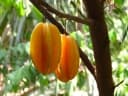
Averrhoa carambola
Averrhoa carambola
Safety & Hazards
None known
Cultivation Details
Plants grow best in the hot humid tropics up to an elevation of around 1,200 metres, though they will tolerate some cool weather and can be grown in subtropical areas[1, 2, 3]. It grows best in areas where annual daytime temperatures are within the range 24 - 30°c, but can tolerate 5 - 39°c[3]. Mature plants can be killed by temperatures of -2°c or lower, although young growth is badly damaged at -1°c[3]. It prefers a mean annual rainfall in the range 1,200 - 2,000mm, but tolerates 600 - 3,000mm[3]. Prefers a position with some shade[3]. Prefers a well-drained soil, plants are intolerant of water-logging[4]. Plants are tolerant of a wide range of soils so long as they are slightly acid[5]. This somewhat contradicts the reports that the plant prefers a pH in the range 5.5 - 6.5, tolerating 5 - 8.5[3]. Requires a position sheltered from strong winds[3]. Plants can tolerate dry periods and some wind if it is not too cold[2]. When young, the carambola is delicate and requires careful attention[2]. Because it is a fast-growing tree, it requires pruning and thinning of excess fruit at an early stage[2]. Flowering continues throughout the year and fruit is available most of the year[2]. The fruit can be very variable when plants are grown from seed, with the best forms being large and sweet and others being small and tart[4]. Three crops per year can be obtained[1]. Seedling varieties should start to crop in 3 - 8 years, whilst selected grafted varieties can start in only 1-2 years[2]. Plants can crop prodigiously[6], and yields of up to 900 kg/year are common for 10-year-old trees[2]. There are many named varieties[7]. Some Brazilian cultivars have a very high content of vitamin C as well as an applicable amount of provitamin A[2].
Propagation
Seed - sow in a nursery seedbed and transplant into individual containers when large enough to handle. They should be ready to plant out when around 6 - 12 months old[8]. The seed has limited viability. Cool temperatures damage the seeds. Viability can be maintained for 6 months with partially dried seeds at 5°c[8]. Greenwood cuttings Budding on to 12 month old seedlings[8] Grafting Layering. This method can produce fruiting plants within 10 months[1]. Cite as: Tropical Plants Database, Ken Fern. tropical.theferns.info. 2026-02-19. <tropical.theferns.info/viewtropical.php?id=Averrhoa+carambola>
Pollinators
Bees, Flies
References
- [1]The New RHS Dictionary of Gardening. 1992. — Huxley. A. · MacMillan Press · 1992 · ISBN 0-333-47494-5 ↩︎Excellent and very comprehensive, though it contains a number of silly mistakes. Readable yet also very detailed.
- [2]World Agroforesty Centre — http://www.worldagroforestry.org/ ↩︎An excellent online database of a huge range of trees giving very good information on each plant - its uses, ecology, identity, propagation, pests etc.
- [3]Ecocrop — http://ecocrop.fao.org/ecocrop/srv/en/home ↩︎Basic information on a wide range of useful plants, plus details of environmental needs where available.
- [4]Tropical Food Gardens — Norrington. L. · Bloomings Books (Melbourne) · 2001 · ISBN 1-876473-41-x ↩︎Excellent little book giving some basic information on a range of plants.
- [5]Perennial Edible Fruits of the Tropics : an Inventory — Martin, F. W.; Campbell, C. W.; Rubertbe, R. M. · U.S. Dept. of Agriculture, Agricultural Research Service · 1987 ↩︎A booklet giving terse details of almost 300 species of edible fruits, plus regional lists of Botanical and Common names for over 2,500 less well-known edible fruits of the tropics.
- [6]Tropical and Subtropical Trees - A Worldwide Encyclopaedic Guide. — Barwick. M. · Thames & Hudson, London · 2004 · ISBN 0-500-51181-0 ↩︎A superb book, very concise and well written, giving a wealth of information on 400 or more species including descriptions, habitat, cultivation details and plant uses. A wealth of colour photographs bring each plant vividly to life.
- [7]Cornucopia II — Facciola. S. · Kampong Publications, California. · 1998 · ISBN 0-9628087-2-5 ↩︎The second edition of an excellent guide to the edible uses of plants, though it does not give any details of cultivation etc.
- [8]Digital Compendium of Forestry Species of Cambodia — www.digitalspecies.blogspot.com; Phnom Penh · 2008 · http://www.digitalspecies.blogspot.com ↩︎A very detailed booklet, produced in PDF format on the internet, giving information on around 100 species of trees.
- [9]Medicinal Plants of the Guianas — DeFilipps, R. A.; Maina, S. L.; & Crepin, J. · Smithsonian Museum · http://botany.si.edu/bdg/medicinal/index.html ↩︎A down-loadable PDF document of a book in pre-publication awaiting illustration. An excellent, if rather terse, guide to the traditional medicinal uses of the plants of the region
- [10]Plants and People of Nepal — Manandhar. N. P. · Timber Press. Oregon. · 2002 · ISBN 0-88192-527-6 ↩︎Excellent book, covering over 1,500 species of useful plants from Nepal together with information on the geography and peoples of Nepal. Good descriptions of the plants with terse notes on their uses.