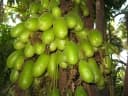
Averrhoa bilimbi
Averrhoa bilimbi
Safety & Hazards
None known
Cultivation Details
A plant of the humid tropical lowlands, where it can also be found at elevations up to 1,200 metres. It grows best in areas where annual daytime temperatures are within the range 23 - 30°c, but can tolerate 10 - 36°c[1]. Mature plants can be killed by temperatures of -3°c or lower, but young growth is severely damaged at -1°c[1]. It prefers a mean annual rainfall in the range 1,200 - 2,300mm, but tolerates 700 - 4,000mm[1]. The trees are found to grow well at low altitudes from sea level up to 500 metres in areas having an even distribution of rainfall throughout the year[2]. They are also quite tolerant to dry periods[2], growing well when there is a 2 - 3 month dry season[3]. The trees are very susceptible to frost injury[4]. Prefers a position in full sun, making rather slow growth in shady or semi-shady situations[3]. The plant thrives well on any soil type provided it is well drained[2]. However, for best performance, it should be grown in deep, fertile, sandy loam or clay loam soils with plenty of organic matter[2]. Grows best in a position sheltered from strong winds[1]. Prefers a pH in the range 5.5 - 6.5, tolerating 5 - 8.3[1]. Trees can commence cropping when 5 - 6 years old from seed[4]. Grafted trees can commence bearing when 2 - 3 years old[1]. A single tree can often yield many hundreds of fruits[5]. Yields from 50 - 150 kilos per tree have been reported[1]. Flowers and fruits are produced throughout most of the year, although there are normally one or two pronounced harvesting seasons, each about 2 months long[1]. Flowering and fruiting occurs especially during the drier part of the year[2, 4].
Propagation
Seed - although trees are usually propagated by seeds, this is generally discouraged when growing as a fruit crop since great variation occurs amongst the seedlings[3]. Marcotting. Usually only done on a garden basis since it is a laborious and slow process and the layers take a long time to root[3]. Budding and grafting. Shield budding is successfully practised in the Philippines and is recommended for large scale propagation. Root cutting may be possible, since it has been observed that severed roots of taling pling trees are able to produce adventitious growths that are able to establish themselves as independent plants[3]. Cite as: Tropical Plants Database, Ken Fern. tropical.theferns.info. 2026-02-19. <tropical.theferns.info/viewtropical.php?id=Averrhoa+bilimbi>
Pollinators
Data unavailable
References
- [1]Ecocrop — http://ecocrop.fao.org/ecocrop/srv/en/home ↩︎Basic information on a wide range of useful plants, plus details of environmental needs where available.
- [2]Under-Utilized Tropical Fruits of Thailand. RAP — Suranant Subhadrabandhu · F. A. O., The United Nations, Bangkok. · 2001 · http://www.fao.org/3/a-ab777e.pdf ↩︎A detailed report on 35 fruit species that could have potential for increased production in Thailand. The report can be downloadd as a PDF from the internet.
- [3]World Agroforesty Centre — http://www.worldagroforestry.org/ ↩︎An excellent online database of a huge range of trees giving very good information on each plant - its uses, ecology, identity, propagation, pests etc.
- [4]Perennial Edible Fruits of the Tropics : an Inventory — Martin, F. W.; Campbell, C. W.; Rubertbe, R. M. · U.S. Dept. of Agriculture, Agricultural Research Service · 1987 ↩︎A booklet giving terse details of almost 300 species of edible fruits, plus regional lists of Botanical and Common names for over 2,500 less well-known edible fruits of the tropics.
- [5]Trade Winds Fruit — http://www.tradewindsfruit.com/index.htm ↩︎The on-line catalogue of a company selling seeds. Gives descriptions, photos and uses of a very wide range of fruit and other food-producing plants plus ornamentals.
- [6]Digital Compendium of Forestry Species of Cambodia — www.digitalspecies.blogspot.com; Phnom Penh · 2008 · http://www.digitalspecies.blogspot.com ↩︎A very detailed booklet, produced in PDF format on the internet, giving information on around 100 species of trees.
- [7]Flora Malesiana Series 1 — Various · Nationaal Herbarium Nederiand, Universiteit Leiden branch · http://www.archive.org ↩︎A massive treatment of the plants of the Malaysian Archipelago. Much of it has been made available to download from the Internet
- [8]Cornucopia II — Facciola. S. · Kampong Publications, California. · 1998 · ISBN 0-9628087-2-5 ↩︎The second edition of an excellent guide to the edible uses of plants, though it does not give any details of cultivation etc.
- [9]Medicinal Plants of the Guianas — DeFilipps, R. A.; Maina, S. L.; & Crepin, J. · Smithsonian Museum · http://botany.si.edu/bdg/medicinal/index.html ↩︎A down-loadable PDF document of a book in pre-publication awaiting illustration. An excellent, if rather terse, guide to the traditional medicinal uses of the plants of the region