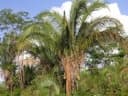
Attalea speciosa
Attalea speciosa
Safety & Hazards
The fine silicate crystals falling off the fruit can cause serious eye damage to the collectors[1].
Cultivation Details
A plant of the lowland humid tropics, where it is found at elevations up to 500 metres[2], though it also succeeds in the subtropics and has some resistance to frost[3]. It grows in areas where the annual rainfall is 1,200 - 2,500 mm with a 4 - 6 months dry season[1]. Requires a sunny position[1]. Soils range from well-drained upland soils to gallery forest, although in severely flooded areas it occurs in elevated, non-flooded areas[1]. Prefers a deep well drained fertile soil[4]. Plants can tolerate some drought[5]. In a primary forest, seedlings require up to seven years to produce the first compound leaf and up to 42 years for other leaves. When cultivated without shade and in more favorable conditions, the plants can take just 10 years to mature[4].. The plant can regenerate very vigorously in open areas, so much so that it is considered to be an invasive weed in land that has been cleared for pasture[5]. The palms begin to bear when 8 - 12 years old[1]. The plant produces bunches of fruit that can be up to 1 metre long, weighing 14 - 90 kg[1]. Each bunch contains from 100 - 600 fruits, with 200 fruits being the average[1]. Wild groves can yield 1.5 - 2.5 tonnes per ha but, where the groves are thinned, yields range from 7 - 30 tonnes per ha with an average of 16 tonnes[1]. Individual trees with 7 bunches, each bunch of 600 nuts and weighing up to 90 kg are known[1].
Propagation
Seed - when stored in the shell, the seed can have a long viability of several years[1]. Fire or heat may be necessary to break dormancy[1]. Separate kernels may germinate within a few months[1]. Early growth is slow, concentrating initially on an extensive root system and consequently requiring large bags if grown in a nursery[1]. Cite as: Tropical Plants Database, Ken Fern. tropical.theferns.info. 2026-02-19. <tropical.theferns.info/viewtropical.php?id=Attalea+speciosa>
Pollinators
Data unavailable
References
- [1]Edible Nuts. — Wickens G.E. · FAO, Rome. · 1995 · http://www.fao.org/docrep/ · ISBN 92-5-103748-5 ↩︎Detailed information on 20 of the most valuable nut crops, plus more basic information on a wide range of other nut-producing plants. It can be downloaded from the Internet.
- [2]The New RHS Dictionary of Gardening. 1992. — Huxley. A. · MacMillan Press · 1992 · ISBN 0-333-47494-5 ↩︎Excellent and very comprehensive, though it contains a number of silly mistakes. Readable yet also very detailed.
- [3]Palm and Cycad Societies of Australia. — http://www.pacsoa.org.au/ ↩︎Contains at least a little information on the majority of palm and cycad species, plus a wealth of photographs. A first class website.
- [4]World Agroforesty Centre — http://www.worldagroforestry.org/ ↩︎An excellent online database of a huge range of trees giving very good information on each plant - its uses, ecology, identity, propagation, pests etc.
- [5]Brazilian Trees. Volume 1. 4th Edition. — Lorenzi. H. · Instituto Plantarum De Estudos Da Flora; Brazil. · 2002 · ISBN 85-86714-17-8 ↩︎Information on 350 species of Brazilian trees. Stunning photographs of each species, brief details on the plant, its uses and how to grow it from seed. A superb work, with the minor irritation that the translation from Portuguese is not of the best.
- [6]Ecocrop — http://ecocrop.fao.org/ecocrop/srv/en/home ↩︎Basic information on a wide range of useful plants, plus details of environmental needs where available.
- [7]Cornucopia II — Facciola. S. · Kampong Publications, California. · 1998 · ISBN 0-9628087-2-5 ↩︎The second edition of an excellent guide to the edible uses of plants, though it does not give any details of cultivation etc.
- [8]Medicinal Plants of Brazil — Mors W.B.; Rizzini C.T.; Pereira N.A. · Reference Publications; Michigan. · 2000 · ISBN 0-917256-42-5 ↩︎An extremely concise book, listing approximately 1,500 species and varieties of plants with their botanical name, common name in Brazil, regions in Brazil where the plant is found, a brief list of uses and any medically active compounds in the plant.
- [9]Useful Fiber Plants of the World — Dodge C.R. · USDA; Washington. · 1897 · http://www.biodiversitylibrary.org/ ↩︎A rather dated, but very comprehensive catalogue of fibre plants from around the world. The book can be downloaded from the Internet.
- [10]CosIng — http://ec.europa.eu/growth/tools-databases/cosing/ ↩︎CosIng is the European Commission database for information on cosmetic substances and ingredients.
- [PFAF]Plants for a Future — pfaf.org ↩︎