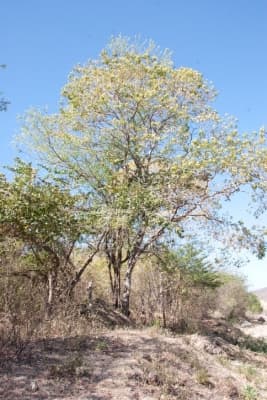
Ateleia herbert-smithii
Ateleia herbert-smithii
Safety & Hazards
None known
Cultivation Details
Requires a sunny position[1]. Prefers dry rocky hillsides but also found on black clay soils and can tolerate waterlogged soils[1]. Established plants are drought-tolerant[1]. Trees do not survive fires very well[1]. This species is the only known dioecious and wind-pollinated species in the family Fabaceae. Both male and female forms need to be grown if fruit and seed are required[1]. Although the male trees are heavily visited by pollen-collecting social bees, the tree is wind-pollinated and the seed wind-dispersed. The wind-dispersed fruits move up to several hundred meters into open pastures. The very small geographic distribution of this tree appears to be due to a combination of its dioecious behaviour, wind pollination, wind-dispersal, and slow rate of reaching an age of abundant seed production (it can take 20 - 30 years before the trees produce seeds)[1]. This species has a symbiotic relationship with certain soil bacteria; these bacteria form nodules on the roots and fix atmospheric nitrogen. Some of this nitrogen is utilized by the growing plant but some can also be used by other plants growing nearby[2].
Propagation
Seed - it has a hard seedcoat and benefits from scarification before sowing in order to speed up and improve germination[1]. This can usually be done by pouring a small amount of nearly boiling water on the seeds (being careful not to cook them!) and then soaking them for 12 - 24 hours in warm water. By this time they should have imbibed moisture and swollen - if they have not, then carefully make a nick in the seedcoat (being careful not to damage the embryo) and soak for a further 12 hours before sowing. Cite as: Tropical Plants Database, Ken Fern. tropical.theferns.info. 2026-02-19. <tropical.theferns.info/viewtropical.php?id=Ateleia+herbert-smithii>
Pollinators
Wind
References
- [1]World Agroforesty Centre — http://www.worldagroforestry.org/ ↩︎An excellent online database of a huge range of trees giving very good information on each plant - its uses, ecology, identity, propagation, pests etc.
- [2]Nodulation Plants in GRIN Taxonomy — United States Department of Agriculture · http://www.ars-grin.gov/~sbmljw/cgi-bin/taxnodul.pl?language=en ↩︎An online database listing plants that have either positive or negative reports on root and stem nodulation with nitrogen-fixing bacteria.