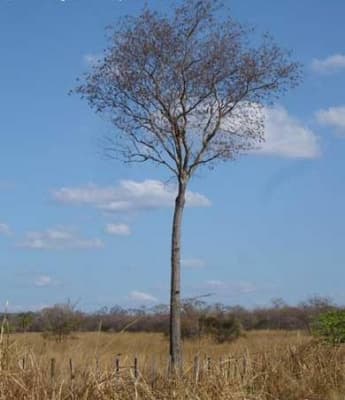
Astronium urundeuva
Astronium urundeuva
Safety & Hazards
None known
Cultivation Details
A plant of the warm temperate zone to the tropics, where it can succeed in semi-arid to moist regions with 2,000mm of rain per year[1]. Prefers a sunny position in a well-drained soil. In different silvicultural trials, trees of 3 years have attained a height of 1.7 metres; trees of 5 years have attained a height of 5.11 metres; and trees of 9 years have attained a height of 9.6 metres with a bole diameter of 97mm[2].
Propagation
Seed - it does not need pre-treatment and is best sown as soon as it is ripe in a semi-shaded nursery bed. A germination rate of more than 80% is normally achieved within 8 - 18 days[1]. The seedlings grow away quickly. Cite as: Tropical Plants Database, Ken Fern. tropical.theferns.info. 2026-02-19. <tropical.theferns.info/viewtropical.php?id=Astronium+urundeuva>
Pollinators
Data unavailable
References
- [1]Brazilian Trees. Volume 1. 4th Edition. — Lorenzi. H. · Instituto Plantarum De Estudos Da Flora; Brazil. · 2002 · ISBN 85-86714-17-8 ↩︎Information on 350 species of Brazilian trees. Stunning photographs of each species, brief details on the plant, its uses and how to grow it from seed. A superb work, with the minor irritation that the translation from Portuguese is not of the best.
- [2]Contribution to an evaluation of tree species using the new CITES Listing Criteria — UNEP-WCMC; Cambridge. · 1999 · http://sea.unep-wcmc.org/species/tree_study/ ↩︎A document produced by UNEP World Conservation Monitoring Centre in 1999. It contains fact sheets on more than 200 tree species from around the globe.
- [3]Neuroprotective Effects of Chalcones from Myracrodruon urundeuva on 6-Hydroxydopamine-Induced Cytotoxicity in Rat Me — Hélio V. Nobre-Júnior et al · Neurochemical Research · 2009 ↩︎A study into the neuroprotective action of Myracroduon urundeuva.
- [4]IUCN Red List of Threatened Species — http://www.iucnredlist.org/ ↩︎A list of plants under threat and facing possible extinction, usually with brief details of the threats and information on habitat.
- [5]Medicinal Plants of Brazil — Mors W.B.; Rizzini C.T.; Pereira N.A. · Reference Publications; Michigan. · 2000 · ISBN 0-917256-42-5 ↩︎An extremely concise book, listing approximately 1,500 species and varieties of plants with their botanical name, common name in Brazil, regions in Brazil where the plant is found, a brief list of uses and any medically active compounds in the plant.
- [6]Dictionary of Economic Plants. — Uphof. J. C. Th. · Weinheim · 1959 · ISBN - ↩︎An excellent and very comprehensive guide but it only gives very short descriptions of the uses without any details of how to utilize the plants. Not for the casual reader.
- [7]Tropix 7 — CIRAD · http://tropix.cirad.fr/en ↩︎An on-line guide to the timbers of 245 species of trees.