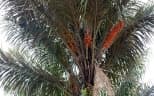
Astrocaryum vulgare
Astrocaryum vulgare
Safety & Hazards
None known
Cultivation Details
A plant of the moist tropical lowlands, where it is found at elevations up to 150 metres. It grows best in areas where annual daytime temperatures are within the range 20 - 28°c, but can tolerate 18 - 30°c[1]. It can be killed by temperatures of 2°c or lower[1]. It prefers a mean annual rainfall in the range 1,300 - 1,800mm, but tolerates 1,000 - 3,000 mm[1]. Requires a sunny, sheltered position[2]. Seedlings require some shade, whilst larger palms thrive in full sun[1]. Plants do not like dry conditions at their roots[2]. Prefers a pH in the range 5 - 7, tolerating 4 - 8[1]. Plants regrow very vigorously from their roots after being cut down or after a fire. They are considered to be a serious weed species of pasture land[3]. Young plants have a moderate rate of growth[3]. Although usually spiny, occasional spineless forms exist in nature[1].
Propagation
The seed is enclosed in a hard endocarp which makes germination slow and erratic[2], and also has a short viability in storage[3]. It may benefit from scarification before sowing to speed up germination. This can usually be done by pouring a small amount of nearly boiling water on the seeds (being careful not to cook them!) and then soaking them for 12 - 24 hours in warm water. By this time they should have imbibed moisture and swollen - if they have not, then carefully make a nick in the seedcoat (being careful not to damage the embryo) and soak for a further 12 hours before sowing. It is best to sow the seed as soon as it is ripe in a partially shaded position in a nursery seedbed or in individual containers. A high germination rate can usually be expected, with the seed sprouting within 90 - 150 days[3]. When the seedbed-sown seedlings are 5 - 8cm tall, pot them up into individual containers and they should be ready to plant out 6 - 9 months later[3]. Cite as: Tropical Plants Database, Ken Fern. tropical.theferns.info. 2026-02-19. <tropical.theferns.info/viewtropical.php?id=Astrocaryum+vulgare>
Pollinators
Data unavailable
References
- [1]Ecocrop — http://ecocrop.fao.org/ecocrop/srv/en/home ↩︎Basic information on a wide range of useful plants, plus details of environmental needs where available.
- [2]Palms of the World — Blombery. A. & Rodd. T. · Angus and Robertson · 1992 · ISBN 0-207-14848-1 ↩︎An excellent guide, well illustrated, with information on cultivation, uses, habitat etc of almost 200 species of Palms.
- [3]Brazilian Trees. Volume 1. 4th Edition. — Lorenzi. H. · Instituto Plantarum De Estudos Da Flora; Brazil. · 2002 · ISBN 85-86714-17-8 ↩︎Information on 350 species of Brazilian trees. Stunning photographs of each species, brief details on the plant, its uses and how to grow it from seed. A superb work, with the minor irritation that the translation from Portuguese is not of the best.
- [4]Edible Nuts. — Wickens G.E. · FAO, Rome. · 1995 · http://www.fao.org/docrep/ · ISBN 92-5-103748-5 ↩︎Detailed information on 20 of the most valuable nut crops, plus more basic information on a wide range of other nut-producing plants. It can be downloaded from the Internet.
- [5]Brazilian Fruits and Cultivated Exotics — Lorenzi. H.; Bacher. L.; Lacerda. M.; Sartori. S. · Instituto Plantarum De Estudos Da Flora LTDA; Brazil. · 2000 · ISBN 85-867174-24-0 ↩︎A superb book, giving information on several hundred fruit species. Each entry has a brief description of the plant and its uses, accompanied by one to many excellent quality photographs of the fruits.
- [6]Field Guide to the Palms of the Americas — Henderson A.; Galeano G.; Bernal R. · Princeton University Press; Princeton, New Jersey. · 1995 · ISBN 0-691-08537-4 ↩︎An excellent book, giving basic information on all the 550 species of palms native to the Americas that were known in 1995. Comprehensive information on the plants range and habitat, brief description, some uses and almost 250 photos.
- [7]Astrocaryum (Palmae) in Amazonia. A Preliminary Treatment — Kahn F. & Millán B. · 1992 ↩︎
- [8]Useful Fiber Plants of the World — Dodge C.R. · USDA; Washington. · 1897 · http://www.biodiversitylibrary.org/ ↩︎A rather dated, but very comprehensive catalogue of fibre plants from around the world. The book can be downloaded from the Internet.
- [9]The genus Astrocaryum (Arecaceae) — Kahn F. · 2008 · ISBN 1727-9933 ↩︎
- [10]Cornucopia II — Facciola. S. · Kampong Publications, California. · 1998 · ISBN 0-9628087-2-5 ↩︎The second edition of an excellent guide to the edible uses of plants, though it does not give any details of cultivation etc.
- [11]Medicinal Plants of the Guianas — DeFilipps, R. A.; Maina, S. L.; & Crepin, J. · Smithsonian Museum · http://botany.si.edu/bdg/medicinal/index.html ↩︎A down-loadable PDF document of a book in pre-publication awaiting illustration. An excellent, if rather terse, guide to the traditional medicinal uses of the plants of the region
- [12]CosIng — http://ec.europa.eu/growth/tools-databases/cosing/ ↩︎CosIng is the European Commission database for information on cosmetic substances and ingredients.
- [PFAF]Plants for a Future — pfaf.org ↩︎