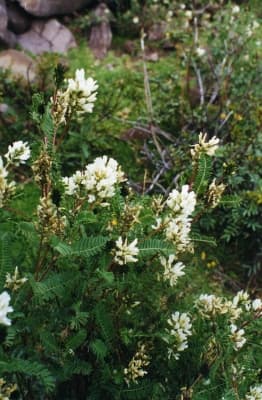
Astragalus garbancillo
Astragalus garbancillo
Safety & Hazards
Many members of this genus contain toxic glycosides[1]. A number of species can accumulate toxic levels of selenium when grown in soils that are relatively rich in that element[1]. All species with edible seedpods can be distinguished by their fleshy round or oval seedpod that looks somewhat like a greengage.[2]
Cultivation Details
A plant of the subtropical to tropical zones, usually found at higher elevations up to 3,500 metres. It can be cultivated outdoors in the warmer regions of the temperate zone, where winters are mild Requires a dry well-drained soil in a sunny position[3]. Plants are intolerant of root disturbance and are best planted in their final positions whilst still small[4]. This species has a symbiotic relationship with certain soil bacteria, these bacteria form nodules on the roots and fix atmospheric nitrogen. Some of this nitrogen is utilized by the growing plant but some can also be used by other plants growing nearby[4]. Many members of this genus can be difficult to grow, this may be due partly to a lack of their specific bacterial associations in the soil[4].
Propagation
Seed - best sown as soon as it is ripe in a cold frame[4]. A period of cold stratification may help stored seed to germinate[4]. Stored seed, and perhaps also fresh seed, should be pre-soaked for 24 hours in hot water before sowing - but make sure that you do not cook the seed[5, 4]. Any seed that does not swell should be carefully pricked with a needle, taking care not to damage the embryo, and re-soaked for a further 24 hours[5, 4]. Germination can be slow and erratic but is usually within 4 - 9 weeks or more at 13°c if the seed is treated or sown fresh[5]. As soon as it is large enough to handle, prick the seedlings out into individual pots and grow them on in the greenhouse for their first winter, planting them out into their permanent positions in late spring or early summer, after the last expected frosts. Cite as: Temperate Plants Database, Ken Fern. temperate.theferns.info. 2026-02-20. <temperate.theferns.info/plant/Astragalus+garbancillo>
Pollinators
Bees, Lepidoptera
References
- [1]A Colour Atlas of Poisonous Plants. — Frohne. D. and Pfänder. J. · Wolfe · 1984 · ISBN 0723408394 ↩︎Brilliant. Goes into technical details but in a very readable way. The best work on the subject that I've come across so far.
- [2]Edible Native Plants of the Rocky Mountains. — Harrington. H. D. · University of New Mexico Press · 1967 · ISBN 0-8623-0343-9 ↩︎A superb book. Very readable, it gives the results of the authors experiments with native edible plants.
- [3]RHS Dictionary of Plants plus Supplement. 1956 — F. Chittendon. · Oxford University Press · 1951 · ISBN - ↩︎Comprehensive listing of species and how to grow them. Somewhat outdated, it has been replaced in 1992 by a new dictionary (see [ 200 ]).
- [4]The New RHS Dictionary of Gardening. 1992. — Huxley. A. · MacMillan Press · 1992 · ISBN 0-333-47494-5 ↩︎Excellent and very comprehensive, though it contains a number of silly mistakes. Readable yet also very detailed.
- [5]Growing from Seed. Volume 2. — Rice. G. (Editor) · Thompson and Morgan. · 1988 · ISBN - ↩︎Very readable magazine with lots of information on propagation. An interesting article on Ensete ventricosum.
- [6]The Ethnobotany of Chinchero. — Franquemont C. Et al · Field Museum of Natural History. · 1990 · http://www.biodiversitylibrary.org · ISBN 0015-0746 ↩︎Brief details on the local uses of plants for an Andean community in southern Peru. It can be downloaded from the Internet.
- [7]Flora of Peru — Macbride. J.F. · Field Museum of Natural History · 1936 ↩︎An excellent attempt at a Flora of Peru, though it is clear that many of the plants were imperfectly known at that time and so information on them was sketchy. Available for download from the Internet.
- [8]Dictionary of Economic Plants. — Uphof. J. C. Th. · Weinheim · 1959 · ISBN - ↩︎An excellent and very comprehensive guide but it only gives very short descriptions of the uses without any details of how to utilize the plants. Not for the casual reader.