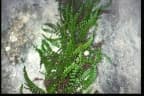
Asplenium trichomanes
Asplenium trichomanes
Safety & Hazards
Although we have found no reports of toxicity for this species, a number of ferns contain carcinogens so some caution is advisable[1]. Many ferns also contain thiaminase, an enzyme that robs the body of its vitamin B complex. In small quantities this enzyme will do no harm to people eating an adequate diet that is rich in vitamin B, though large quantities can cause severe health problems. The enzyme is destroyed by heat or thorough drying, so cooking the plant will remove the thiaminase[2].
Cultivation Details
A plant widely spread through the temperate zone, it is also found at higher elevations in some areas of the tropics. Plants are hardy to about -30°c[1]. Requires a well-drained position and lots of old mortar rubble in the soil[3]. Requires a humid atmosphere and some shade[4, 5]. A good plant for growing on a shady part of an old dry-stone or brick wall[PFAF]. Members of this genus are rarely if ever troubled by browsing deer[6].
Propagation
Spores - best sown as soon as they are ripe on the surface of a humus-rich sterilized soil. Keep the compost moist, preferably by putting a plastic bag over the pot. The spores usually germinate in the spring[3]. Spring sown spores germinate in 1 - 3 months at 15°c[7]. Pot on small clumps of plantlets as soon as they are large enough to handle and grow them on in light shade in a greenhouse. Keep the plants humid until they are well established. Once the plants are 15cm or more tall, plant them out into their permanent positions in the spring. Cite as: Temperate Plants Database, Ken Fern. temperate.theferns.info. 2026-02-20. <temperate.theferns.info/plant/Asplenium+trichomanes>
Pollinators
Data unavailable
References
- [1]The New RHS Dictionary of Gardening. 1992. — Huxley. A. · MacMillan Press · 1992 · ISBN 0-333-47494-5 ↩︎Excellent and very comprehensive, though it contains a number of silly mistakes. Readable yet also very detailed.
- [2]Discovering Wild Plants - Alaska, W. Canada and the Northwest. — Schofield. J. J. · Alaska Northwest Books; Alaska · 2003 · ISBN 0882403699 ↩︎A nice guide to some useful plants in that area.
- [3]RHS Dictionary of Plants plus Supplement. 1956 — F. Chittendon. · Oxford University Press · 1951 · ISBN - ↩︎Comprehensive listing of species and how to grow them. Somewhat outdated, it has been replaced in 1992 by a new dictionary (see [ 200 ]).
- [4]Plants for Shade. — Knight. F. P. · Royal Horticultural Society. · 1980 · ISBN 0-900629-78-9 ↩︎A small but informative booklet listing plants that can be grown in shady positions with a few cultivation details.
- [5]Shade Plants for Garden and Woodland. — Brown. ↩︎
- [6]Perennial Garden Plants — Thomas. G. S. · J. M. Dent & Sons, London. · 1990 · ISBN 0 460 86048 8 ↩︎A concise guide to a wide range of perennials. Lots of cultivation guides, very little on plant uses.
- [7]Growing from Seed. Volume 2. — Rice. G. (Editor) · Thompson and Morgan. · 1988 · ISBN - ↩︎Very readable magazine with lots of information on propagation. An interesting article on Ensete ventricosum.
- [8]Flora of the British Isles. — Clapham, Tutin and Warburg. · Cambridge University Press · 1962 · ISBN - ↩︎A very comprehensive flora, the standard reference book but it has no pictures.
- [9]A Modern Herbal. — Grieve. · Penguin · 1984 · ISBN 0-14-046-440-9 ↩︎Not so modern (1930's?) but lots of information, mainly temperate plants.
- [10]Glossary of Indian Medicinal Plants (Including the Supplement). — Chopra. R. N., Nayar. S. L. and Chopra. I. C. · Council of Scientific and Industrial Research, New Delhi. · 1986 · ISBN - ↩︎Very terse details of medicinal uses of plants with a wide range of references and details of research into the plants chemistry. Not for the casual reader.
- [11]Native American Ethnobotany — Moerman. D. · Timber Press. Oregon. · 1998 · ISBN 0-88192-453-9 ↩︎Very comprehensive but terse guide to the native uses of plants. Excellent bibliography, fully referenced to each plant, giving a pathway to further information. Not for the casual reader.
- [12]American Fern Journal Vol.60 — American Fern Society · 1970 · http://www.biodiversitylibrary.org ↩︎Contains an article on the medicinal uses of Indian ferns. It can be downloaded from the Internet.
- [PFAF]Plants for a Future — pfaf.org ↩︎