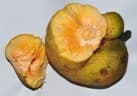
Artocarpus lacucha
Artocarpus lacucha
Safety & Hazards
None known
Cultivation Details
A plant of the humid tropics, where it is found at elevations from near sea level to 1,300 metres[1, 2]. It grows best in areas where annual daytime temperatures are within the range 22 - 32°c, but can tolerate 8 - 47°c[3]. It can be killed by temperatures of -1°c or lower[3]. It prefers a mean annual rainfall in the range 1,500 - 3,000mm, but tolerates 1,200 - 5,000mm, with a distinct dry season of up to 3 months[2, 3, 4]. Prefers a deep, well-drained soil[1]. It prefers deep permeable soils with a good supply of moisture[2]. Young plants need some shade, but need increasing light levels as they mature[1]. Prefers a pH in the range 5 - 6.5, tolerating 4 - 7.5[3].
Propagation
Seed - it has a very short viability and so is best sown as soon as it is ripe[1]. The seedcoat is very thin - the seeds need to be handled carefully to avoid damaging them[2]. Sow seeds in a nursery seedbed, or sow 2 seeds per individual container - any surplus seedlings can be moved to another pot[2]. The seed germinates best at a temperature of 24 - 27°c[1]. The seed germinates quite quickly and, when 2 - 3 weeks old, are robust enough to withstand full sun and rain[2]. Seedlings are planted out when about 20 - 25cm tall[2]. Root cuttings. Air layering. Cite as: Tropical Plants Database, Ken Fern. tropical.theferns.info. 2026-02-19. <tropical.theferns.info/viewtropical.php?id=Artocarpus+lacucha>
Pollinators
Insects?
References
- [1]The New RHS Dictionary of Gardening. 1992. — Huxley. A. · MacMillan Press · 1992 · ISBN 0-333-47494-5 ↩︎Excellent and very comprehensive, though it contains a number of silly mistakes. Readable yet also very detailed.
- [2]Seed Leaflets — Various · Forest & Landscape. Denmark · http://en.sl.life.ku.dk/Publikationer/Udgivelser/PopulaerPublikationer.aspx?katid={D28373CC-6EF3-4EF8-B097-6D83FABF209E}&serieid={9F1C3DB1-6E7B-4CF1-AF53-F480B0CB40EF}&sort=title ↩︎A series of leaflets, jointly produced by the University of Copenhagen and the Royal Botanic Gardens at Kew, focussing on seed information for a number species, but also giving a lot of other information about each plant.
- [3]Ecocrop — http://ecocrop.fao.org/ecocrop/srv/en/home ↩︎Basic information on a wide range of useful plants, plus details of environmental needs where available.
- [4]Journal of the Arnold Arboretum. Vol. 41 — Harvard University; Boston, Mass. · 1960 · http://www.biodiversitylibrary.org ↩︎Contains a treatment of the genus Artocarpus, section Pseudojaca. It can be downloaded from the Internet.
- [5]Brazilian Fruits and Cultivated Exotics — Lorenzi. H.; Bacher. L.; Lacerda. M.; Sartori. S. · Instituto Plantarum De Estudos Da Flora LTDA; Brazil. · 2000 · ISBN 85-867174-24-0 ↩︎A superb book, giving information on several hundred fruit species. Each entry has a brief description of the plant and its uses, accompanied by one to many excellent quality photographs of the fruits.
- [6]Dictionary of Economic Plants. — Uphof. J. C. Th. · Weinheim · 1959 · ISBN - ↩︎An excellent and very comprehensive guide but it only gives very short descriptions of the uses without any details of how to utilize the plants. Not for the casual reader.
- [7]Flora of Pakistan — http://www.efloras.org ↩︎As of 2006, there is not much information on habitats available, but it is being developed and promises to be an excellent resource.
- [8]Mansfeld's Database of Agricultural and Horticultural Plants — http://mansfeld.ipk-gatersleben.de/pls/htmldb_pgrc/f?p=185:3:4292127278597336 ↩︎Terse details of a huge range of useful plants.
- [9]World Agroforesty Centre — http://www.worldagroforestry.org/ ↩︎An excellent online database of a huge range of trees giving very good information on each plant - its uses, ecology, identity, propagation, pests etc.
- [10]Cornucopia II — Facciola. S. · Kampong Publications, California. · 1998 · ISBN 0-9628087-2-5 ↩︎The second edition of an excellent guide to the edible uses of plants, though it does not give any details of cultivation etc.
- [11]Flora of China — Missouri Botanical Garden Press; St. Louis. · 1994 · http://flora.huh.harvard.edu/china/ ↩︎An excellent, comprehensive resource in 25 volumes. In addition to the botanical information the flora also gives basic information on habitat and some uses. An on-line version is also available.
- [12]Plants and People of Nepal — Manandhar. N. P. · Timber Press. Oregon. · 2002 · ISBN 0-88192-527-6 ↩︎Excellent book, covering over 1,500 species of useful plants from Nepal together with information on the geography and peoples of Nepal. Good descriptions of the plants with terse notes on their uses.
- [13]Useful Fiber Plants of the World — Dodge C.R. · USDA; Washington. · 1897 · http://www.biodiversitylibrary.org/ ↩︎A rather dated, but very comprehensive catalogue of fibre plants from around the world. The book can be downloaded from the Internet.