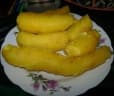
Arracacia xanthorrhiza
Arracacia xanthorrhiza
Safety & Hazards
None known
Cultivation Details
Cultivation of Arracacha usually takes place at higher elevation of 1,800 - 3,500 metres in the Tropics, though it can also be grown at lower elevations down to 600 metres[1, 2]. It can be grown as a half-hardy perennial in the warmer regions of the Temperate zone, the roots being harvested in the autumn, stored overwinter in a cool frost-free place and then planted out in the spring[3]. Attempts in the 19th century to cultivate it as a commercial crop in Europe, however, were unsuccessful[4]. It grows best in areas where annual daytime temperatures are within the range 14 - 21°c, but can tolerate 10 - 28°c[2]. It prefers a mean annual rainfall in the range 800 - 1,200mm, but tolerates 600 - 1,800mm[2]. Requires a sunny position[2]. Prefers a good loam. Grows best in a well-drained sandy loam with a pH in the range of 5 to 6[5, 1]. Prefers a pH in the range 5 - 6, tolerating 4.5 - 6.5. Plants take about 120 - 240 days from planting to produce a first crop and 300 - 400 days to produce a crop of mature tubers[5]. At harvest time there can be as many as 10 tubers each the size of a carrot formed around the central root[5]. One plant can yield 2 - 3 kg of edible roots, total yields of 40 tonnes per hectare are possible[5]. Preventing the plant from flowering can increase yields[5]. Plants might be sensitive to daylength, possibly requiring short days to initiate tuber production, and so may not be suitable for temperate climates[5, 1]. They also have a longer growing season than potatoes and are frost-tender so need a relatively long growing season[5]. Plants do not always produce viable seed in S. America[5].
Propagation
Seed - sow spring in a greenhouse and only just cover the seed. Do not allow the compost to dry out. Germination is often poor, less than 50%[5]. Since this species is believed to be a hybrid it will probably not breed true from seed. When large enough to handle, prick the seedlings out into individual pots and grow them on for the first year in a greenhouse and plant out in late spring after the last expected frosts. Division. Harvest the roots in the autumn, store overwinter and plant out in the spring. The plant forms a clump of tubers around a central root, each tuber can be used to grow a new plant. Traditionally the base of the tuber is repeatedly slashed to stimulate shoots to form and encourage a uniform arrangement of lateral roots. They are then left for a few days to heal before planting them out[5]. Cite as: Temperate Plants Database, Ken Fern. temperate.theferns.info. 2026-02-20. <temperate.theferns.info/plant/Arracacia+xanthorrhiza>
Pollinators
Insects
References
- [1]Vegetables in the Tropics — Tindall. H. D. · MacMillan, Oxford. · 1983 · ISBN 0-333-24268-8 ↩︎An excellent, in-depth look at the main vegetable crops that can be grown in the Tropics, plus many less well-known plants.
- [2]Ecocrop — http://ecocrop.fao.org/ecocrop/srv/en/home ↩︎Basic information on a wide range of useful plants, plus details of environmental needs where available.
- [3]RHS Dictionary of Plants plus Supplement. 1956 — F. Chittendon. · Oxford University Press · 1951 · ISBN - ↩︎Comprehensive listing of species and how to grow them. Somewhat outdated, it has been replaced in 1992 by a new dictionary (see [ 200 ]).
- [4]Sturtevant's Edible Plants of the World. — Hedrick. U. P. · Dover Publications · 1972 · ISBN 0-486-20459-6 ↩︎Lots of entries, quite a lot of information in most entries and references.
- [5]Lost Crops of the Incas — Popenoe. H. et al · National Academy Press · 1990 · ISBN 0-309-04264-X ↩︎An excellent book. Very readable, with lots of information and good pictures of some lesser known food plants of S. America.
- [6]Dictionary of Economic Plants. — Uphof. J. C. Th. · Weinheim · 1959 · ISBN - ↩︎An excellent and very comprehensive guide but it only gives very short descriptions of the uses without any details of how to utilize the plants. Not for the casual reader.
- [7]A Dictionary of Plants Used by Man. — Usher. G. · Constable · 1974 · ISBN 0094579202 ↩︎Forget the sexist title, this is one of the best books on the subject. Lists a very extensive range of useful plants from around the world with very brief details of the uses. Not for the casual reader.
- [8]Plants for Human Consumption. — Kunkel. G. · Koeltz Scientific Books · 1984 · ISBN 3874292169 ↩︎An excellent book for the dedicated. A comprehensive listing of Latin names with a brief list of edible parts.
- [9]Alternative Foods. — Sholto-Douglas. J. ↩︎Not very comprehensive, it seems more or less like a copy of earlier writings with little added.
- [10]The Ethno-Botany of Pre-Columbian Peru. — Towle. M. A. · Aldine Publishing Co. Chicago. · 1961 ↩︎A very interesting book covering quite a lot of information on plant uses in S. America although many of the plants are not suitable for temperate areas.
- [11]Economic Botany. — Hill. A. F. · The Maple Press · 1952 · ISBN - ↩︎Not very comprehensive, but it is quite readable and goes into some detail about the plants it does cover.
- [12]Cornucopia - A Source Book of Edible Plants. — Facciola. S. · Kampong Publications · 1990 · ISBN 0-9628087-0-9 ↩︎Excellent. Contains a very wide range of conventional and unconventional food plants (including tropical) and where they can be obtained (mainly N. American nurseries but also research institutes and a lot of other nurseries from around the world.
- [13]Cornucopia II — Facciola. S. · Kampong Publications, California. · 1998 · ISBN 0-9628087-2-5 ↩︎The second edition of an excellent guide to the edible uses of plants, though it does not give any details of cultivation etc.