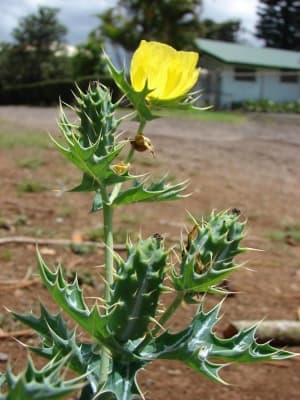
Argemone mexicana
Argemone mexicana
Safety & Hazards
All parts of the plant, including the seed, contain toxic alkaloids[1]. The seed oil is toxic, causing intense pain all over the body, diarrhoea or constipation, and fever[2]. The seeds have caused many fatalities in poultry[2] The dried leaves are considered poisonous in fodder for cattle[2].
Cultivation Details
Prickly poppy occurs mainly in regions with a pronounced dry season, mostly at sea-level, but sometimes up to 3,000 metres[2]. It is a very adaptable plant and is also able to grow in subhumid climates. It is not very cold-hardy, however, able to tolerate occasional temperatures down to around -5 and -10°c[3]. It is often grown as an annual in temperate climates, able to flower in its first year from seed[4]. Easily grown in a light soil in a sunny position[4, 5, 6]. Does best in a poor well-drained soil[5]. Plants can tolerate a wide range of soils[7]. The plant can flower and produce seed all year round[2]. The plant resents being transplanted and should be sown in situ[5].
Propagation
Seed - sow in situ[3]. The seed usually germinates in 3 - 4 weeks at 15°c[5]. The seed can remain dormant in the soil for many years[8]. Cite as: Temperate Plants Database, Ken Fern. temperate.theferns.info. 2026-02-20. <temperate.theferns.info/plant/Argemone+mexicana>
Pollinators
Self, Bees, Insects
References
- [1]Focus on Plants. Volume 5. (formerly 'Growing from seed') — Bird. R. (Editor) · Thompson and Morgan. · 1991 · ISBN - ↩︎Very readable magazine with lots of information on propagation. A good article on Corydalis spp.
- [2]Plant Resources of Southeast Asia — http://proseanet.org/ ↩︎Lots of information on the uses of the plants of SE Asia.
- [3]The New RHS Dictionary of Gardening. 1992. — Huxley. A. · MacMillan Press · 1992 · ISBN 0-333-47494-5 ↩︎Excellent and very comprehensive, though it contains a number of silly mistakes. Readable yet also very detailed.
- [4]RHS Dictionary of Plants plus Supplement. 1956 — F. Chittendon. · Oxford University Press · 1951 · ISBN - ↩︎Comprehensive listing of species and how to grow them. Somewhat outdated, it has been replaced in 1992 by a new dictionary (see [ 200 ]).
- [5]Growing from Seed. Volume 2. — Rice. G. (Editor) · Thompson and Morgan. · 1988 · ISBN - ↩︎Very readable magazine with lots of information on propagation. An interesting article on Ensete ventricosum.
- [6]The Milder Garden. — Taylor. J. · Dent · 1990 ↩︎A good book on plants that you didn't know could be grown outdoors in Britain.
- [7]Pacific Island Ecosystems at Risk — http://www.hear.org/pier/scientificnames/index.html ↩︎A very good website detailing weed species that have been introduced into the Pacific Islands.
- [8]Protabase - Plant Resources of Tropical Africa. — http://www.prota.org ↩︎An excellent on-line database with detailed information on over 3,200 species of useful plants of Africa.
- [9]Manual of the Southeastern Flora. — Small J.K. · University of N. Carolina Press. · 1933 · http://www.biodiversitylibrary.org ↩︎Getting rather dated now, an immense work covering the flora of Southeastern N. America. No pictures, it is not for the casual reader. It can be downloaded from the Internet.
- [10]Narcotic Plants — Emboden. W. · Studio Vista · 1979 · ISBN 0-289-70864-8 ↩︎A lot of details about the history, chemistry and use of narcotic plants, including hallucinogens, stimulants, inebriants and hypnotics.
- [11]Plants for Human Consumption. — Kunkel. G. · Koeltz Scientific Books · 1984 · ISBN 3874292169 ↩︎An excellent book for the dedicated. A comprehensive listing of Latin names with a brief list of edible parts.
- [12]Dictionary of Economic Plants. — Uphof. J. C. Th. · Weinheim · 1959 · ISBN - ↩︎An excellent and very comprehensive guide but it only gives very short descriptions of the uses without any details of how to utilize the plants. Not for the casual reader.
- [13]A Dictionary of Plants Used by Man. — Usher. G. · Constable · 1974 · ISBN 0094579202 ↩︎Forget the sexist title, this is one of the best books on the subject. Lists a very extensive range of useful plants from around the world with very brief details of the uses. Not for the casual reader.
- [14]Chinese Materia Medica. — Stuart. Rev. G. A. · Taipei. Southern Materials Centre · 1911 · ISBN - ↩︎A translation of an ancient Chinese herbal. Fascinating.
- [15]Meet Flora Mexicana. — Pesman. M. W. · Dale S. King. Arizona. · 1962 · ISBN - ↩︎Very readable flora but rather lacking botanically. A few notes on useful plants.
- [16]The Encyclopedia of Medicinal Plants — Chevallier. A. · Dorling Kindersley. London · 1996 · ISBN 9-780751-303148 ↩︎An excellent guide to over 500 of the more well known medicinal herbs from around the world.
- [17]Glossary of Indian Medicinal Plants (Including the Supplement). — Chopra. R. N., Nayar. S. L. and Chopra. I. C. · Council of Scientific and Industrial Research, New Delhi. · 1986 · ISBN - ↩︎Very terse details of medicinal uses of plants with a wide range of references and details of research into the plants chemistry. Not for the casual reader.
- [18]Medicinal Plants of Nepal — Dept. of Medicinal Plants. Nepal. · 1993 · ISBN - ↩︎Terse details of the medicinal properties of Nepalese plants, including cultivated species and a few imported herbs.
- [19]The History and Folklore of North American Wild Flowers. — Coffey. T. · Facts on File. · 1993 · ISBN 0-8160-2624-6 ↩︎A nice read, lots of information on plant uses.
- [20]Plants and People of Nepal — Manandhar. N. P. · Timber Press. Oregon. · 2002 · ISBN 0-88192-527-6 ↩︎Excellent book, covering over 1,500 species of useful plants from Nepal together with information on the geography and peoples of Nepal. Good descriptions of the plants with terse notes on their uses.
- [21]Flowering Plants of the World. — Haywood. V. H. · Oxford University Press · ISBN 0-19-217674-9 ↩︎Very readable and well illustrated, it lists plants by families giving the basic diagnostic features and some details of plant uses.
- [22]Economic Botany. — Hill. A. F. · The Maple Press · 1952 · ISBN - ↩︎Not very comprehensive, but it is quite readable and goes into some detail about the plants it does cover.