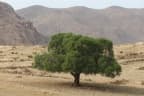
Argania spinosa
Argania spinosa
Safety & Hazards
None known
Cultivation Details
A plant of very arid areas, mainly in the subtropical areas of northwest Africa, but just entering the tropics in Mauritania, where it is found at elevations up to 1,500 metre[1]. It grows best in areas where annual daytime temperatures are within the range 20 - 30°c, but can tolerate 10 - 35°c[1]. Mature plants can be killed by temperatures of -2°c or lower, but new growth is severely damaged at 0°c[1]. It prefers a mean annual rainfall in the range 200 - 300mm, but tolerates 100 - 400mm[1]. Requires a sunny position[1]. Succeeds in a wide range of soils, including very poor, dry soils[1]. The tree is well suited to calcareous soils, sandy deposits and relatively poor semi desert soils conditions but not drifting sands or water-logged soils[2]. Prefers a pH in the range 6.5 - 7.5, tolerating 6 - 8[1]. Established plants are very drought tolerant - they can shed their foliage and remain in a state of dormancy for several years during prolonged droughts[1]. Trees may start to bear when 5 - 6 years old from seed, and reach maximum production at the age of 60 years[1]. Average fruit yield may be about 8 kg per tree[1]. A long-lived species, with trees living for 200 - 400 years[1]. Trees respond very well to coppicing[2].
Propagation
Seed - Cite as: Tropical Plants Database, Ken Fern. tropical.theferns.info. 2026-02-19. <tropical.theferns.info/viewtropical.php?id=Argania+spinosa>
Pollinators
Data unavailable
References
- [1]Ecocrop — http://ecocrop.fao.org/ecocrop/srv/en/home ↩︎Basic information on a wide range of useful plants, plus details of environmental needs where available.
- [2]World Agroforesty Centre — http://www.worldagroforestry.org/ ↩︎An excellent online database of a huge range of trees giving very good information on each plant - its uses, ecology, identity, propagation, pests etc.