Cultivation Details
HabitEvergreen Tree
Growth—
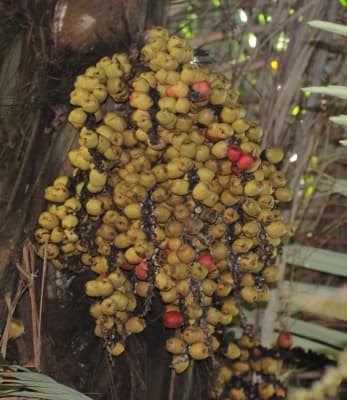
Grows best in a sunny position[2]. Unlike the majority of species in this genus, Arenga obtusifolia does not die after flowering. Flowering stems arise from every node on the stem, commencing at the lowest node and continuing upwards as the plant continues to grow[1].
Propagation
Seed - a deep root is formed before the seedling emerges above soil level, and so the seed should be sown in individual, deep containers. Pre-soak the seed for 24 hours in warm water before sowing. It can take 3 - 6 months or more before signs of growth are seen above soil level[1]. Cite as: Tropical Plants Database, Ken Fern. tropical.theferns.info. 2026-02-19. <tropical.theferns.info/viewtropical.php?id=Arenga+obtusifolia>
Pollinators
Data unavailable
References
- [1]Plant Resources of Southeast Asia — http://proseanet.org/ ↩︎Lots of information on the uses of the plants of SE Asia.
- [2]Palm and Cycad Societies of Australia. — http://www.pacsoa.org.au/ ↩︎Contains at least a little information on the majority of palm and cycad species, plus a wealth of photographs. A first class website.
- [3]Heart of Palm Use: A Family Survey — Scott Zona, Ph.D. · Fairchild Tropical Botanic Garden, Virtual Herbarium. · http://www.virtualherbarium.org/palmresearch/Hearts_of_Palm_table.html ↩︎An on-line article listing the botanical names and range of palm trees that have an edible apical bud.
- [PFAF]Plants for a Future — pfaf.org ↩︎