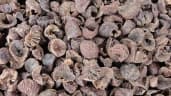
Areca catechu
Areca catechu
Safety & Hazards
Excessive use of this plant causes profuse salivation, vomiting and stupor[1].
Cultivation Details
Plants succeed in moist tropical climates where temperatures never fall below 10°c, the average annual rainfall is 1,500mm or more and the driest month has 25mm or more rain[2]. Prefers a mean annual rainfall in the range 1,500 - 5,000mm, evenly distributed through the year[3]. Although tolerant to moderate elevations on mountains, it generally does best at low elevations, especially near the coast[4, 3]. Prefers a moist, well-drained soil and a position in full sun[1]. Being a shade-loving species, the betel palm always does well when grown as a mixed crop with fruit trees[4]. Prefers a pH in the range 5.5 - 6, tolerating 4.5 - 6.8[5]. Plants are drought sensitive[4]. Trees can commence bearing fruit in 6 - 10 years from seed[6]. Trees can flower throughout the year[6]. The sweet-scented male flowers are visited by bees and other insects for nectar, but insects have not been observed visiting the female flowers. It is thought that most of the flowers are wind pollinated[4]. The use of this herb is subject to legal restrictions in some countries[1].
Propagation
Seed - sow in containers[2]. The seed has a short viability so only fresh seed should be used[2]. Germination usually takes place in 6 - 13 weeks[2]. Areca nut is exclusively seed propagated. Seed nuts are allowed to ripen completely on the tree and then dried in the sun for 1-2 days before sowing 2.5 cm apart in shallow pits. Drying does not seem to improve germination rate. Cite as: Tropical Plants Database, Ken Fern. tropical.theferns.info. 2026-02-19. <tropical.theferns.info/viewtropical.php?id=Areca+catechu>
Pollinators
Wind
References
- [1]Encyclopaedia of Herbs and their Uses. — Bown. D. · Dorling Kindersley, London. · 1995 · ISBN 0-7513-020-31 ↩︎A very well presented and informative book on herbs from around the globe. Plenty in it for both the casual reader and the serious student. Just one main quibble is the silly way of having two separate entries for each plant.
- [2]Palms of the World — Blombery. A. & Rodd. T. · Angus and Robertson · 1992 · ISBN 0-207-14848-1 ↩︎An excellent guide, well illustrated, with information on cultivation, uses, habitat etc of almost 200 species of Palms.
- [3]Trees Commonly Cultivated in SE Asia — Jensen. M. · FAO Regional Office, Bangkok. · 1999 · ISBN 974-89377-5-5 ↩︎
- [4]World Agroforesty Centre — http://www.worldagroforestry.org/ ↩︎An excellent online database of a huge range of trees giving very good information on each plant - its uses, ecology, identity, propagation, pests etc.
- [5]Ecocrop — http://ecocrop.fao.org/ecocrop/srv/en/home ↩︎Basic information on a wide range of useful plants, plus details of environmental needs where available.
- [6]Perennial Edible Fruits of the Tropics : an Inventory — Martin, F. W.; Campbell, C. W.; Rubertbe, R. M. · U.S. Dept. of Agriculture, Agricultural Research Service · 1987 ↩︎A booklet giving terse details of almost 300 species of edible fruits, plus regional lists of Botanical and Common names for over 2,500 less well-known edible fruits of the tropics.
- [7]Medicinal Plants in Papua New Guinea — World Health Organisation · 2009 · ISBN 978-92-9061-249-0 ↩︎Traditional medicinal uses of 126 species from Papua New Guinea, including information on modern research into the plants.
- [8]The New RHS Dictionary of Gardening. 1992. — Huxley. A. · MacMillan Press · 1992 · ISBN 0-333-47494-5 ↩︎Excellent and very comprehensive, though it contains a number of silly mistakes. Readable yet also very detailed.
- [9]Agroforestry in the Pacific Islands: Systems for Sustainability — W.C. Clarke and R.R. Thaman (Editors) · United Nations University Press, Tokyo · 1993 · http://www.unu.edu/unupress/unupbooks/80824e/80824E00.htm#Contents · ISBN 92-808-0824-9 ↩︎The guide includes information on 100 species of plants for Agroforestry. It is also available on the web at the address given above.
- [10]Dictionary of Economic Plants. — Uphof. J. C. Th. · Weinheim · 1959 · ISBN - ↩︎An excellent and very comprehensive guide but it only gives very short descriptions of the uses without any details of how to utilize the plants. Not for the casual reader.
- [11]Cornucopia II — Facciola. S. · Kampong Publications, California. · 1998 · ISBN 0-9628087-2-5 ↩︎The second edition of an excellent guide to the edible uses of plants, though it does not give any details of cultivation etc.
- [12]Useful Fiber Plants of the World — Dodge C.R. · USDA; Washington. · 1897 · http://www.biodiversitylibrary.org/ ↩︎A rather dated, but very comprehensive catalogue of fibre plants from around the world. The book can be downloaded from the Internet.
- [13]Inhibition of Meliodogyne incognita Egg Hatching by Herbal Extracts — Elbadri G.A.A.; Dong Woon Lee; Jung Chan Park; Ho Yul Choo; · 2008 ↩︎