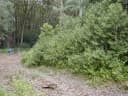
Ardisia elliptica
Ardisia elliptica
Safety & Hazards
None known
Cultivation Details
The plant is usually found in areas where the mean annual rainfall is 1,500mm or more[1]. Plants are shade tolerant, but can also succeed in full sun[2, 1]. Prefers a moist or even wet, fertile soil, and can succeed in clay[3, 1]. The plant is often grown as an ornamental. It has escaped from cultivation in many areas, is considered to be invasive in many places including southern Florida, and has been declared a noxious weed in Hawaii. It grows rapidly, forming dense monotypic stands in pastures and mesic forest that prevent establishment of all other species[2]. Frugivorous birds are the principal dispersal agents of the seeds, being attracted to the numerous red to blackish fruits[2]. A fast-growing tree[3]. The plant may grow as much as 1 metre in the first year as a sprout, but seedlings and established shrubs grow quite slowly, usually only 25 - 50cm a year in height[1]. Plants can flower and produce seed within 2 - 4 years from seed, when no more than 2 metres tall[3, 4]. The plant flowers and produces fruit sporadically throughout the year[1]. The tree is probably not resistant to fire[2]. The likely lifespan of a plant is between 10 - 25 years[1].
Propagation
Seed - around 99% of fresh seed is viable[3]. Sown without any pretreatment in a commercial potting mix, 75% of the seed germinated within 42 - 81 days after sowing[1]. Cite as: Tropical Plants Database, Ken Fern. tropical.theferns.info. 2026-02-19. <tropical.theferns.info/viewtropical.php?id=Ardisia+elliptica>
Pollinators
Data unavailable
References
- [1]Wildland Shrubs of the United States and its Territories: Thamnic Descriptions — Francis J.K. (Editor) · USDA; Forest Service International Institute of Tropical Forestr · 2000 · http://www.fs.fed.us/global/iitf/wildland_shrubs.htm ↩︎An excellent series of papers, in PDF format, from various authors giving quite detailed information on a range of shrubs growing in the United States and its Territories. It can be downloaded from the Internet.
- [2]Pacific Island Ecosystems at Risk — http://www.hear.org/pier/scientificnames/index.html ↩︎A very good website detailing weed species that have been introduced into the Pacific Islands.
- [3]Global Invasive Species Database — http://www.issg.org/database/welcome/ ↩︎Very detailed information on almost 400 species (with more being added) of plants that have become weeds in areas outside their native range.
- [4]Australian Tropical Rainforest Plants — http://www.anbg.gov.au/cpbr/cd-keys/rfk/index.html ↩︎An online resource giving botanical information, and a little bit about plant usage, for over 2,700 species of plants found in the Australian rainforest.
- [5]Plants of Southeast Asia — http://www.asianplant.net/ ↩︎Excellent site with brief information on the plant, its range, habitat and uses, plus phots of specimens, close-ops of flowers and leaves etc,
- [6]Asean Tropical Plant Database — http://211.114.21.20/tropicalplant/index.jsp ↩︎Terse details, with photos, of many of the plants growing in the tropical forests of southeast Asia. Gives some details of plant uses along with a description of the plant and its range.
- [7]Plant Resources of Southeast Asia — http://proseanet.org/ ↩︎Lots of information on the uses of the plants of SE Asia.
- [8]Medicinal Plants of Asia and the Pacific — Wiart C. · CRC Press, Taylor & Francis Group; Florida. · 2006 · ISBN 0-8493-7245-3 ↩︎An excellent look at a range of plants, in particular focussing on the active principles that could be responsible for the medical activities.