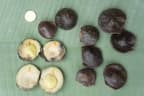
Archidendron pauciflorum
Archidendron pauciflorum
Safety & Hazards
Although we have no specific information for this species, the seeds of several other members of this genus contain the amino acid derivative djenkolic acid. Ingestion of seed containing this substance can cause the formation of sharp needle-like crystals of djenkolic acid in the kidney or urinary tract. In severe cases, crystals of djenkolic acid have been found in urine. Indeed, people who are suffering from djenkolism show similar symptoms to those suffering from kidney or urinary stones, a condition for which it has been frequently mistaken[1].
Cultivation Details
A tree of the moist tropics, where it can be found at elevations up to 1,200 metres. This species has a symbiotic relationship with certain soil bacteria, these bacteria form nodules on the roots and fix atmospheric nitrogen. Some of this nitrogen is utilized by the growing plant but some can also be used by other plants growing nearby[2].
Propagation
Seed - Cite as: Tropical Plants Database, Ken Fern. tropical.theferns.info. 2026-02-19. <tropical.theferns.info/viewtropical.php?id=Archidendron+pauciflorum>
Pollinators
Data unavailable
References
- [1]Under-Utilized Tropical Fruits of Thailand. RAP — Suranant Subhadrabandhu · F. A. O., The United Nations, Bangkok. · 2001 · http://www.fao.org/3/a-ab777e.pdf ↩︎A detailed report on 35 fruit species that could have potential for increased production in Thailand. The report can be downloadd as a PDF from the internet.
- [2]The New RHS Dictionary of Gardening. 1992. — Huxley. A. · MacMillan Press · 1992 · ISBN 0-333-47494-5 ↩︎Excellent and very comprehensive, though it contains a number of silly mistakes. Readable yet also very detailed.
- [3]Flora Malesiana Series 1 — Various · Nationaal Herbarium Nederiand, Universiteit Leiden branch · http://www.archive.org ↩︎A massive treatment of the plants of the Malaysian Archipelago. Much of it has been made available to download from the Internet
- [4]Five hundred plant species in Gunung Halimun Salak National Park, West Java — Hari Priyadi et al · Center for International Forestry Research; Indonesia. · 2010 · http://www.cifor.cgiar.org · ISBN 978-602-8693-22-6 ↩︎Brief details of the uses of 500 Indonesian plants. It is available as a PDF document to download from the internet.
- [PFAF]Plants for a Future — pfaf.org ↩︎