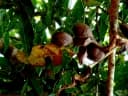
Archidendron jiringa
Archidendron jiringa
Safety & Hazards
Djenkolic acid, an amino acid derivative, has been found in the seed. Ingestion of the seed can cause the formation of sharp needle-like crystals of djenkolic acid in the kidney or urinary tract. In severe cases, crystals of djenkolic acid have been found in urine. Indeed, people who are suffering from djenkolism show similar symptoms to those suffering from kidney or urinary stones, a condition for which it has been frequently mistaken[1].
Cultivation Details
A plant of the humid tropics, where it is found at elevations up to 1,600 metres. It grows best in areas where annual daytime temperatures are within the range 20 - 30°c, but can tolerate 12 - 40°c[2]. It prefers a mean annual rainfall in the range 2,000 - 3,000mm, but tolerates 1,000 - 4,000mm[2]. Grows well in full sun and in light shade[2]. Prefers a well-drained soil[3]. It is found growing on sandy soils, lateritic soils and reddish sandy clay on flat land and low undulating hills[3]. Prefers a pH in the range 5.5 - 6.5, tolerating 4.5 - 7[2]. Although most species in the family Fabaceae have a symbiotic relationship with bacteria on their roots that can fix atmospheric nitrogen, there is a report that this species does not have this relationship.
Propagation
Seed - Cite as: Tropical Plants Database, Ken Fern. tropical.theferns.info. 2026-02-19. <tropical.theferns.info/viewtropical.php?id=Archidendron+jiringa>
Pollinators
Moths, Insects
References
- [1]Under-Utilized Tropical Fruits of Thailand. RAP — Suranant Subhadrabandhu · F. A. O., The United Nations, Bangkok. · 2001 · http://www.fao.org/3/a-ab777e.pdf ↩︎A detailed report on 35 fruit species that could have potential for increased production in Thailand. The report can be downloadd as a PDF from the internet.
- [2]Ecocrop — http://ecocrop.fao.org/ecocrop/srv/en/home ↩︎Basic information on a wide range of useful plants, plus details of environmental needs where available.
- [3]World Agroforesty Centre — http://www.worldagroforestry.org/ ↩︎An excellent online database of a huge range of trees giving very good information on each plant - its uses, ecology, identity, propagation, pests etc.
- [4]Flora Malesiana Series 1 — Various · Nationaal Herbarium Nederiand, Universiteit Leiden branch · http://www.archive.org ↩︎A massive treatment of the plants of the Malaysian Archipelago. Much of it has been made available to download from the Internet
- [5]Nuts. — Howes. F. N. · Faber · 1948 · ISBN - ↩︎Rather old but still a masterpiece. Has sections on tropical and temperate plants with edible nuts plus a section on nut plants in Britain. Very readable.
- [6]Plants of Southeast Asia — http://www.asianplant.net/ ↩︎Excellent site with brief information on the plant, its range, habitat and uses, plus phots of specimens, close-ops of flowers and leaves etc,
- [7]Cornucopia II — Facciola. S. · Kampong Publications, California. · 1998 · ISBN 0-9628087-2-5 ↩︎The second edition of an excellent guide to the edible uses of plants, though it does not give any details of cultivation etc.
- [8]Dictionary of Economic Plants. — Uphof. J. C. Th. · Weinheim · 1959 · ISBN - ↩︎An excellent and very comprehensive guide but it only gives very short descriptions of the uses without any details of how to utilize the plants. Not for the casual reader.
- [9]Mansfeld's Database of Agricultural and Horticultural Plants — http://mansfeld.ipk-gatersleben.de/pls/htmldb_pgrc/f?p=185:3:4292127278597336 ↩︎Terse details of a huge range of useful plants.