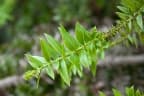
Araucaria bidwillii
Araucaria bidwillii
Safety & Hazards
None known
Cultivation Details
A plant of warm temperate to tropical regions, mainly occurring in humid subtropical lowland areas. It is found in areas with an annual rainfall of approximately 1,050 mm and temperatures ranging between freezing and 30°c[1]. Plants can experience up to 30 mild frosts each year[1].. Grows well in full sun and in part shade[2]. Succeeds in most soils[3]. Plants are resistant to salt spray[3]. The trees generally begin to flower and fruit between the ages of 15 and 20 years[1]. Male and female flowers are typically found on different parts of the same tree[1]. Male flowers usually appear at the base of the crown in young trees and female flowers at the top. As the tree grows older, the male and female flowers move closer to each other[1]. Bisexual flowers are also found[1]. After pollination, the female flowers develop slowly; the cones maturing in about 2 years[1]. They disintegrate on the tree or fall to the ground and disintegrate[1]. Trees bear seeds in 1 - 2 year intervals[1]. Abundant seed is produced in ‘mast years’ at approximately three-year intervals. Seeds remain in the cone until after it falls off the tree[4]. Trees may coppice slightly from cut branches and stems[1].
Propagation
Seed - best sown as soon as it is ripe in a greenhouse[5] or it can be stored cool and moist then sown late winter in a greenhouse[6, 7]. The seed usually germinates in 1 - 2 months at 15°c[5]. As soon as they are large enough to handle, prick the seedlings out into individual pots. The plants have a rather sparse root system and are best placed in their final positions as soon as possible. Give them some protection from the cold for at least their first winter[PFAF]. Cite as: Temperate Plants Database, Ken Fern. temperate.theferns.info. 2026-02-20. <temperate.theferns.info/plant/Araucaria+bidwillii>
Pollinators
Wind
References
- [1]World Agroforesty Centre — http://www.worldagroforestry.org/ ↩︎An excellent online database of a huge range of trees giving very good information on each plant - its uses, ecology, identity, propagation, pests etc.
- [2]Trade Winds Fruit — http://www.tradewindsfruit.com/index.htm ↩︎The on-line catalogue of a company selling seeds. Gives descriptions, photos and uses of a very wide range of fruit and other food-producing plants plus ornamentals.
- [3]Australian Native Plants. — Wrigley. J. W. and Fagg. M. · Collins. (Australia) · 1988 · ISBN 0-7322-0021-0 ↩︎A lovely book, written in order to encourage Australian gardeners to grow their native plants. A little bit of information for the plant project.
- [4]IUCN Red List of Threatened Species — http://www.iucnredlist.org/ ↩︎A list of plants under threat and facing possible extinction, usually with brief details of the threats and information on habitat.
- [5]Growing from Seed. Volume 2. — Rice. G. (Editor) · Thompson and Morgan. · 1988 · ISBN - ↩︎Very readable magazine with lots of information on propagation. An interesting article on Ensete ventricosum.
- [6]Propagation of Trees, Shrubs and Conifers. — Sheat. W. G. · MacMillan and Co · 1948 · ISBN - ↩︎A bit dated but a good book on propagation techniques with specific details for a wide range of plants.
- [7]Hardy Woody Plants from Seed. — McMillan-Browse. P. · Grower Books · 1985 · ISBN 0-901361-21-6 ↩︎Does not deal with many species but it is very comprehensive on those that it does cover. Not for casual reading.
- [8]Sturtevant's Edible Plants of the World. — Hedrick. U. P. · Dover Publications · 1972 · ISBN 0-486-20459-6 ↩︎Lots of entries, quite a lot of information in most entries and references.
- [9]Flora of Australia — http://www.anbg.gov.au/abrs/abif/flora/ ↩︎The full information from the Flora of Australia - on-line. An excellent resource.
- [10]Tropical and Subtropical Trees - A Worldwide Encyclopaedic Guide. — Barwick. M. · Thames & Hudson, London · 2004 · ISBN 0-500-51181-0 ↩︎A superb book, very concise and well written, giving a wealth of information on 400 or more species including descriptions, habitat, cultivation details and plant uses. A wealth of colour photographs bring each plant vividly to life.
- [11]Conifers. — Rushforth. K. · Christopher Helm · 1987 · ISBN 0-7470-2801-X ↩︎Deals with conifers that can be grown outdoors in Britain. Good notes on cultivation and a few bits about plant uses.
- [12]A Field Guide to Australian Trees. — Holliday. I. and Hill. R. · Frederick Muller Ltd. · 1974 · ISBN 0-85179-627-3 ↩︎A well illustrated and very readable book, but it does not contain much information for the plant project.
- [13]RHS Dictionary of Plants plus Supplement. 1956 — F. Chittendon. · Oxford University Press · 1951 · ISBN - ↩︎Comprehensive listing of species and how to grow them. Somewhat outdated, it has been replaced in 1992 by a new dictionary (see [ 200 ]).
- [14]Cornucopia - A Source Book of Edible Plants. — Facciola. S. · Kampong Publications · 1990 · ISBN 0-9628087-0-9 ↩︎Excellent. Contains a very wide range of conventional and unconventional food plants (including tropical) and where they can be obtained (mainly N. American nurseries but also research institutes and a lot of other nurseries from around the world.
- [15]Useful Wild Plants in Australia. — Cribb. A. B. and J. W. · William Collins Pty Ltd. Sidney · 1981 · ISBN 0-00-216441-8 ↩︎A very readable book.
- [16]Plants and People of Nepal — Manandhar. N. P. · Timber Press. Oregon. · 2002 · ISBN 0-88192-527-6 ↩︎Excellent book, covering over 1,500 species of useful plants from Nepal together with information on the geography and peoples of Nepal. Good descriptions of the plants with terse notes on their uses.
- [PFAF]Plants for a Future — pfaf.org ↩︎