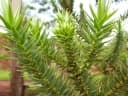
Araucaria angustifolia
Araucaria angustifolia
Safety & Hazards
None known
Cultivation Details
Found in humid areas of the tropics and subtropics, which experience a mild to hot summer without a dry season[1]. The plant is found at elevations between 200 - 2,200 metres, but is only found below 500 metres where cool air flows from the highlands towards the valleys[2]. It grows best in areas where annual daytime temperatures are within the range 18 - 23°c, but can tolerate 9 - 27°c[2]. Mature plants can be killed by temperatures of -5°c or lower, but new growth will be severely damaged at 0°c[2]. It prefers a mean annual rainfall in the range 1,500 - 2,000mm, but tolerates 1,250 - 2,500mm[2]. Grows best in a sunny position[2]. Prefers a medium-textured, moist but well-drained soil[2]. Prefers a pH in the range 5.5 - 6.5, tolerating 5 - 7.5[2]. Established plants are drought tolerant[2]. Optimum annual wood production is 10 - 23 cubic metres per hectare[2]. A dioecious species, both male and female forms need to be grown if fruit and seed are required[3].
Propagation
Seed - best sown as soon as it is ripe in individual containers[4, 3]. The seed usually germinates in 1 - 2 months at 15°c[4]. The plants have a rather sparse root system and are best placed in their final positions as soon as possible. Cite as: Tropical Plants Database, Ken Fern. tropical.theferns.info. 2026-02-19. <tropical.theferns.info/viewtropical.php?id=Araucaria+angustifolia>
Pollinators
Wind
References
- [1]Global Tree Campaign - 40 Species in Trade — http://www.unep-wcmc.org/trees/trade/40_species_in_trade.htm ↩︎Information on the habitats, uses and some cultivation notes for 40 species of timber trees.
- [2]Ecocrop — http://ecocrop.fao.org/ecocrop/srv/en/home ↩︎Basic information on a wide range of useful plants, plus details of environmental needs where available.
- [3]Brazilian Trees. Volume 1. 4th Edition. — Lorenzi. H. · Instituto Plantarum De Estudos Da Flora; Brazil. · 2002 · ISBN 85-86714-17-8 ↩︎Information on 350 species of Brazilian trees. Stunning photographs of each species, brief details on the plant, its uses and how to grow it from seed. A superb work, with the minor irritation that the translation from Portuguese is not of the best.
- [4]Growing from Seed. Volume 2. — Rice. G. (Editor) · Thompson and Morgan. · 1988 · ISBN - ↩︎Very readable magazine with lots of information on propagation. An interesting article on Ensete ventricosum.
- [5]The Gymnosperm Database — http://www.conifers.org/index.htm ↩︎A vast amount of information on conifers and families of gymnosperms.
- [6]Flora Parana — http://www.chaua.org.br/pagina/floraparana-catalogo-plantas-nativas-do-parana ↩︎Not quite a flora, but an on-line listing of many of the plants of Parana in southern Brazil. Good photographs, plus descriptions and details of plant uses.
- [7]Dictionary of Economic Plants. — Uphof. J. C. Th. · Weinheim · 1959 · ISBN - ↩︎An excellent and very comprehensive guide but it only gives very short descriptions of the uses without any details of how to utilize the plants. Not for the casual reader.
- [8]IUCN Red List of Threatened Species — http://www.iucnredlist.org/ ↩︎A list of plants under threat and facing possible extinction, usually with brief details of the threats and information on habitat.
- [9]Cornucopia II — Facciola. S. · Kampong Publications, California. · 1998 · ISBN 0-9628087-2-5 ↩︎The second edition of an excellent guide to the edible uses of plants, though it does not give any details of cultivation etc.
- [10]Tropical Timbers of the World. Ag. Handbook No. 607. — Chudnoff. Martin. · USDA Forest Service. Wisconsin. · 1984 ↩︎Terse details on the properties of the wood of almost 400 species of trees from the Tropics.
- [11]Tropix 7 — CIRAD · http://tropix.cirad.fr/en ↩︎An on-line guide to the timbers of 245 species of trees.