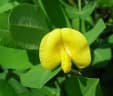
Arachis pintoi
Arachis pintoi
Safety & Hazards
None known
Cultivation Details
A plant of the moist tropics, also succeeding in humid subtropical areas. It is found at elevations up to 1,400 metres. It grows best in areas where annual daytime temperatures are within the range 22 - 28°c, but can tolerate 12 - 30°c[1]. Top growth is killed by frost, but plants can regrow from the taproot if the frost was only light[2]. It prefers a mean annual rainfall in the range 1,500 - 2,000mm, but tolerates 900 - 3,000mm, and can tolerate a dry period of up to 4 months[3, 1]. The plant grows best in light shade, but is also tolerant of full sun and heavy shade[4]. It grows well in most soil types, preferring a fertile soil but succeeding in soils of low fertility[1]. It cannot reproduce in heavy clay soils, or in any soils that form a hard cap after rain, because the developing seedpod is unable to penetrate the soil and dies[2]. It can tolerate low levels of salt in the soil[1]. It prefers a well-drained soil, but can tolerate some water logging[1]. Prefers a pH in the range 5.4 - 6, tolerating 4.5 - 7.5[1]. There are no reports about this species becoming a weed. However, once established it is very difficult to eradicate, spreading by stolons for up to 2 metres a year in the wet tropics and about 1 metres a year in the subtropics. Since the seed develops underground any natural dissemination can only be by water erosion. The seeds are soft and digestible and are not spread through animals[2]. Seedlings develop quickly following germination, and with good growing conditions and several plants per square metre, a complete ground cover can be achieved by a network of stolons in less than six months[4]. Flowering commences three to four weeks after emergence and continues through the growing season, appearing to intensify following rain or irrigation[4]. The develping seedpod is borne on a gynophore or peg, which elongates to up to 27cm after pollination and pushes the seedpod up to 7cm deep into the soil[4]. Plants are rarely subjected to fire in their native habitat. However, high levels of seed in the soil, plus the capacity to re-establish new crowns at depth if the surface crown is destroyed, ensure a good recovery after fire[2]. This species has a symbiotic relationship with certain soil bacteria; these bacteria form nodules on the roots and fix atmospheric nitrogen. Some of this nitrogen is utilized by the growing plant but some can also be used by other plants growing nearby[5].
Propagation
Seed - when fresh it has a high level of dormancy, which may be reduced by drying the seed at 35 - 40°c for 10 days. When growing the plant in new areas, the seed should be inoculated with a specific strain of Bradyrhizobium, which is different from that used on commercial groundnuts. Sow the seed in situ - a well-prepared seed-bed is desirable but not essential. The seed should be sown 2 - 6cm deep at a rate of 10 - 15 kilos of seed per hectare, followed by rolling[4]. The seed remains viable in the ground for more than one season[4]. If seed is not available, pinto peanut is readily propagated from cuttings. Cite as: Tropical Plants Database, Ken Fern. tropical.theferns.info. 2026-02-19. <tropical.theferns.info/viewtropical.php?id=Arachis+pintoi>
Pollinators
Data unavailable
References
- [1]Ecocrop — http://ecocrop.fao.org/ecocrop/srv/en/home ↩︎Basic information on a wide range of useful plants, plus details of environmental needs where available.
- [2]Tropical Forages — http://www.tropicalforages.info/key/Forages/Media/Html/index.htm ↩︎Mainly focussed on forage plants, the site gives a lot of information on the plant, with a good botanical description, details of cultivation, plant uses and a good selection of photographs.
- [3]Grassland Species - Profiles — http://www.fao.org/ag/AGP/AGPC/doc/Gbase/Default.htm ↩︎Terse information on over 650 species of plants that grow in grassland, including trees, shrubs and perennial plants as well as grasses. Gives a brief description of the plant, its range and habitat and some of its uses.
- [4]Plant Resources of Southeast Asia — http://proseanet.org/ ↩︎Lots of information on the uses of the plants of SE Asia.
- [5]Nodulation Plants in GRIN Taxonomy — United States Department of Agriculture · http://www.ars-grin.gov/~sbmljw/cgi-bin/taxnodul.pl?language=en ↩︎An online database listing plants that have either positive or negative reports on root and stem nodulation with nitrogen-fixing bacteria.