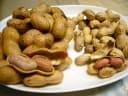
Arachis hypogaea
Arachis hypogaea
Safety & Hazards
Of greatest concern is possible contamination of damaged or spoiled seeds with the teratogenic, carcinogenic aflatoxins. Two principal toxins, aflatoxins B, and G, and their less toxic dihydro derivatives, aflatoxins B2 and G2 are formed by the aflatoxin producing moulds (Aspergillus flavus et al). Prevention of mould growth is the mainstay, there being no satisfactory way to remove the toxins from feed and foods (however, peanut oils are free of aflatoxins because of alkaline processing)[1].
Cultivation Details
Peanuts can be grown from the tropics to the warm temperate zone, with commercial crops succeeding between latitudes 40° south and 40° north[2] and up to an elevation of 1,500 metres[3]. Crops can be grown at further distances from the equator but yields are likely to be poor[2]. Young growth is not frost-hardy and most cultivars require too long a growing season to make them a viable crop in most of the temperate zone. An average monthly temperature of 22 - 27°c produces the best crops, whilst growth ceases at about 15°c[3, 4]. An annual precipitation in the range 750 - 1,250mm is preferred, though as little as 500mm can be sufficient if well distributed[3]. A distinct dry period is required to allow the seed to ripen[3]. Prefers a light humus-rich well-drained soil in a warm sunny sheltered position, though it will tolerate heavier soils[2, 1]. Heavy clays and any soils that tend to form a crust or cap after rain are unsuitable since the fertilized flowers need to be able to penetrate the soil easily[3]. Plants prefer hot dry conditions when the crop is ripening[2]. Peanuts are quite tolerant of acid soils, and aluminium, requiring a minimum of lime for acceptable yields[1]. Tolerates a pH in the range 4.3 to 8.7[1], though around 6.5 is preferred[3]. Yields average about 1 tonne of unshelled nuts per hectare, about 80% of this weight is edible seeds (erect forms) and 60 - 75% (running forms)[2]. There are three main groups of cultivars:- 'Virginia' has large seeds. 'Valencia' has four seeds per pod. 'Spanish' has the smallest seeds[2]. There are running and erect forms in each group[2]. The erect forms mature more quickly and are therefore more likely to succeed in cooler areas[2]. 'Early Spanish' matures in 105 days and has cropped reliably as far north as Canada[5]. 'Spanish' matures in 110 days and crops in Canada if grown in a light sandy soil with southern exposure[5]. Plants are, in general, self-pollinating, though occasional outcrossing by bees occurs[1]. All types of peanut are daylength neutral and photoperiod does not appear to affect flower initiation[3]. This species has a symbiotic relationship with certain soil bacteria, these bacteria form nodules on the roots and fix atmospheric nitrogen. Some of this nitrogen is utilized by the growing plant but some can also be used by other plants growing nearby[2]. When removing plant remains at the end of the growing season, it is best to only remove the aerial parts of the plant, leaving the roots in the ground to decay and release their nitrogen.
Propagation
Seed - pre-soak for 12 hours in warm water and sow the seed in mid spring in a warm greenhouse. Germination should take place within 2 weeks. When large enough to handle, prick the seedlings out into individual pots of fairly rich soil and grow them on fast, planting them out after the last expected frosts and giving them some protection (such as a cloche) until they have settled down and are growing well. Cite as: Temperate Plants Database, Ken Fern. temperate.theferns.info. 2026-02-20. <temperate.theferns.info/plant/Arachis+hypogaea>
Pollinators
Insects
References
- [1]Handbook of Energy Crops — Duke. J. · - · 1983 · https://hort.purdue.edu/newcrop/duke_energy/dukeindex.html · ISBN - ↩︎Published only on the Internet, excellent information on a wide range of both temperate and tropical plants.
- [2]The New RHS Dictionary of Gardening. 1992. — Huxley. A. · MacMillan Press · 1992 · ISBN 0-333-47494-5 ↩︎Excellent and very comprehensive, though it contains a number of silly mistakes. Readable yet also very detailed.
- [3]Vegetables in the Tropics — Tindall. H. D. · MacMillan, Oxford. · 1983 · ISBN 0-333-24268-8 ↩︎An excellent, in-depth look at the main vegetable crops that can be grown in the Tropics, plus many less well-known plants.
- [4]Plant Resources of Southeast Asia — http://proseanet.org/ ↩︎Lots of information on the uses of the plants of SE Asia.
- [5]Cornucopia - A Source Book of Edible Plants. — Facciola. S. · Kampong Publications · 1990 · ISBN 0-9628087-0-9 ↩︎Excellent. Contains a very wide range of conventional and unconventional food plants (including tropical) and where they can be obtained (mainly N. American nurseries but also research institutes and a lot of other nurseries from around the world.
- [6]Protabase - Plant Resources of Tropical Africa. — http://www.prota.org ↩︎An excellent on-line database with detailed information on over 3,200 species of useful plants of Africa.
- [7]Medicinal Plants of China — Duke. J. A. and Ayensu. E. S. · Reference Publications, Inc. · 1985 · ISBN 0-917256-20-4 ↩︎Details of over 1,200 medicinal plants of China and brief details of their uses. Often includes an analysis, or at least a list of constituents. Heavy going if you are not into the subject.
- [8]Encyclopaedia of Medicinal Plants. — Chiej. R. · MacDonald · 1984 · ISBN 0-356-10541-5 ↩︎Covers plants growing in Europe. Also gives other interesting information on the plants. Good photographs.
- [9]Dictionary of Economic Plants. — Uphof. J. C. Th. · Weinheim · 1959 · ISBN - ↩︎An excellent and very comprehensive guide but it only gives very short descriptions of the uses without any details of how to utilize the plants. Not for the casual reader.
- [10]The Encyclopedia of Herbs and Herbalism — Stuart. M. (Editor) · Orbis Publishing. London. · 1979 · ISBN 0-85613-067-2 ↩︎Excellent herbal with good concise information on over 400 herbs.
- [PFAF]Plants for a Future — pfaf.org ↩︎