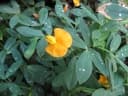
Arachis glabrata
Arachis glabrata
Safety & Hazards
None known
Cultivation Details
Plants are productive from about latitudes 30°N and 30°c to near the equator. They have persisted in areas receiving rainfall as low as 750 mm per year but are probably best suited to areas receiving 1,000 - 2,000 mm[1]. Unlike many tropical legumes, it can compete successfully with sward-forming grasses[1]. It grows best when mean monthly temperatures are above about 20°c. Although tops are cut by frost, plants regrow vigorously with the onset of warmth and moisture[1]. During very dry conditions, top growth may die off, but rhizomes mostly survive, providing a nucleus for recovery[1]. Grows successfully on soils with textures ranging from sands to clays provided they are well-drained[1]. While apparently preferring acid soils, it has produced good yields on neutral to slightly alkaline soils[1]. It grows well on soils low in phosphorus[1] This species has a symbiotic relationship with certain soil bacteria, these bacteria form nodules on the roots and fix atmospheric nitrogen. Some of this nitrogen is utilized by the growing plant but some can also be used by other plants growing nearby[2]. When planting in new areas, it is generally not necessary to inoculate the rhizomes[1]. Four cultivars have been released in Florida: 'Arb', 'Arblick', 'Florigraze' and 'Arbrook'. 'Arb' and 'Arblick' were selected initially, based on productivity and spreading ability respectively; 'Florigraze' was selected because it combined both characteristics, and 'Arbrook', the most recent release, because it is more drought-tolerant than 'Florigraze' but is of similar productivity[1]. One accession known as the Maiwa peanut (probably the Australian accession CPI 12121) has persisted well in Indonesia[1].
Propagation
Despite often dense flowering, few seeds are set, except in some accessions prior to dense sward development[1]. Seedlings are usually quite large before they form rhizomes[1]. The plant is best propagated from rhizomes. While pieces of rhizome as short as 5 cm may strike, it is generally considered best to plant 30 cm square pieces of rhizome mat about 1.8 metres apart[1]. Alternatively, the rhizomes can be teased out, broadcast over the soil surface and disked in[1]. Rhizomes are planted at a depth of 3 cm in clay soils to 6.5 cm in coarse sands[1]. A clean seed-bed is preferable, to minimize competition for the developing plants[1]. Ideally, rhizomes should be produced in sandy soils for ease of digging[1]. Planting appears to be most successful when rhizomes are dormant[1]. With adequate temperature and moisture, shoots usually emerge 2 - 3 weeks after planting; dense swards develop as rhizomes form and extend the margins of the stand at up to 2 metres per year in the absence of competition, or 5 - 30 cm per year with grass competition[1]. Cite as: Tropical Plants Database, Ken Fern. tropical.theferns.info. 2026-02-19. <tropical.theferns.info/viewtropical.php?id=Arachis+glabrata>
Pollinators
Insects
References
- [1]Plant Resources of Southeast Asia — http://proseanet.org/ ↩︎Lots of information on the uses of the plants of SE Asia.
- [2]The New RHS Dictionary of Gardening. 1992. — Huxley. A. · MacMillan Press · 1992 · ISBN 0-333-47494-5 ↩︎Excellent and very comprehensive, though it contains a number of silly mistakes. Readable yet also very detailed.
- [3]Dictionary of Economic Plants. — Uphof. J. C. Th. · Weinheim · 1959 · ISBN - ↩︎An excellent and very comprehensive guide but it only gives very short descriptions of the uses without any details of how to utilize the plants. Not for the casual reader.