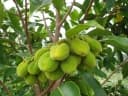
Aquilaria crassna
Aquilaria crassna
Safety & Hazards
None known
Cultivation Details
A plant of the moist tropics, where it is found mainly at elevations from 300 - 900 metres[1]. It grows best in areas where annual daytime annual temperatures are in the range 22 - 28°c, though it can tolerate 14 - 40°c[2]. The absolute minimum temperature it experiences is 5°c[2]. It is found in areas where the mean annual rainfall ranges from 1,500 - 6,500mm, with a dry season ranging from 0 - 4 months[2]. Requires a sunny position according to some reports[1, 2], whilst others say that it can tolerate some shade[2]. Young plants grow well in some shade, but require more light as they grow larger[2, 3]. Trees have to be at least 15 - 20 years old before they produce deposits of the aromatic resin known as agar wood or eagle wood[1]. Three closely related species of Aquilaria are considered to be the major sources of agar wood and are distinguished by the length of their calyx lobes:- Aquilaria crassna, which comes from Indo-China, has lobes 12 - 15mm long. Aquilaria malaccensis, from India, and Malaysia has lobes 2 - 3mm long. Aquilaria sinensis, from China, has lobes 8mm long.
Propagation
Seed - it has a very short viability of less than 10 weeks and needs to be sown as soon as possible after harvesting[1]. No pre-treatment is required. Sow in a nursery seedbed, only just covering the seed and leaving the tail above soil level. Germination usually starts within 10 days and can be spread over one month[1]. Root cuttings are easy if rooting hormones are used[1]. Air layering works well if rooting hormones are used[1]. Cite as: Tropical Plants Database, Ken Fern. tropical.theferns.info. 2026-02-19. <tropical.theferns.info/viewtropical.php?id=Aquilaria+crassna>
Pollinators
Data unavailable
References
- [1]Seed Leaflets — Various · Forest & Landscape. Denmark · http://en.sl.life.ku.dk/Publikationer/Udgivelser/PopulaerPublikationer.aspx?katid={D28373CC-6EF3-4EF8-B097-6D83FABF209E}&serieid={9F1C3DB1-6E7B-4CF1-AF53-F480B0CB40EF}&sort=title ↩︎A series of leaflets, jointly produced by the University of Copenhagen and the Royal Botanic Gardens at Kew, focussing on seed information for a number species, but also giving a lot of other information about each plant.
- [2]Digital Compendium of Forestry Species of Cambodia — www.digitalspecies.blogspot.com; Phnom Penh · 2008 · http://www.digitalspecies.blogspot.com ↩︎A very detailed booklet, produced in PDF format on the internet, giving information on around 100 species of trees.
- [3]Trees of Laos and Vietnam - A Field Guide to 100 species. — Hoang Van Sam; Khamseng Nanthavong; Kessler P.J.A. · Blumea · 2004 ↩︎A detailed guide, with excellent line-drawings, to 100 of the more important trees of Laos and Vietnam. A very good work, giving lots of information about each plant. Originally published in the journal Blumea, it is available as a PDF on the Interne
- [4]IUCN Red List of Threatened Species — http://www.iucnredlist.org/ ↩︎A list of plants under threat and facing possible extinction, usually with brief details of the threats and information on habitat.
- [5]Plant Resources of Southeast Asia — http://proseanet.org/ ↩︎Lots of information on the uses of the plants of SE Asia.
- [6]Improved Lipid Profile Associated with Daily Consumption of Tri-Sura-Phon in Healthy Overweight Volunteers: An Open- — Sirigoon Kuamsub et al · 2017 · https://doi.org/10.1155/2017/2687173 ↩︎