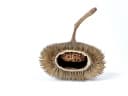
Malvaceae FAMILY
Apeiba tibourbou
Apeiba tibourbou
Edibility
0/5
Medicinal
2/5
Safety & Hazards
None known
Cultivation Details
HabitEvergreen Tree
GrowthFast
Prefers a sunny position[1]. Newly planted young trees establish well and grow away rapidly, easily reaching a height of 4 metres within 2 years from seed[1].
Propagation
Seed - best sown as soon as it is ripe in a lightly shaded position in a nursery seedbed. Germination rates are usually low, with the seed sprouting within 15 - 20 days. Transplant the seedlings into individual containers when 3 - 5cm tall and they can be ready for planting out 4 - 5 months later[1]. Cite as: Tropical Plants Database, Ken Fern. tropical.theferns.info. 2026-02-19. <tropical.theferns.info/viewtropical.php?id=Apeiba+tibourbou>
Pollinators
Data unavailable
References
- [1]Brazilian Trees. Volume 1. 4th Edition. — Lorenzi. H. · Instituto Plantarum De Estudos Da Flora; Brazil. · 2002 · ISBN 85-86714-17-8 ↩︎Information on 350 species of Brazilian trees. Stunning photographs of each species, brief details on the plant, its uses and how to grow it from seed. A superb work, with the minor irritation that the translation from Portuguese is not of the best.
- [2]Flora of Guatemala — Standley P.C. & J. A. Steyermark · 1946 - 1976 · http://www.archive.org/ ↩︎A superb reference, though somewhat dated. Gives lots of plant uses as well as information on plant habit and habitat. The entire flora (13 volumes) can now be downloaded from http://www.archive.org/
- [3]South American Timbers: the Properties, Uses and Characteristics of 190 Species. — Bolza. E. & Christensen. F.J. · Commonwealth Scientific and Industrial Research Organization · 1979 · ISBN 0 643 02582 0 ↩︎A very useful guide.
- [4]Fruits of the Guianan Flora — van Roosmalen. M.G.M. · Institute of Systematic Boyany, Utrecht University; Netherlands. · 1985 · ISBN 90-9000988-4 ↩︎Terse descriptions of over 1,700 species from the Guianas that bear fruits - not necessarily edible! Often mentions if the fruit is edible, plus gives brief description of habit and habitat.
- [5]Technical Information on 134 Species of Bolivian Woods — USDA Forest Service -- Forest Products Lab · USDA Forest Service · http://www2.fpl.fs.fed.us/publications/ ↩︎A PDF file, available for download. Exactly what the title says, brief and to the point.
- [6]Contributions from the United States National Herbarium Vol. 27 — Standley P.C. · Smithsonian Institute; Washington. · 1928 · http://www.biodiversitylibrary.org ↩︎Contains a Flora of the Panama Canal zone
- [7]Trees and Shrubs of Mexico — Standley P.C. · Smithsonian Institution; Washington · 1926 ↩︎Although dated, it contains a wealth of information on the trees and shrubs of Mexico, including many of their uses. It can be downloaded from the Internet.
- [8]Evaluation of the antimalarial activity of plants used by the Chacobo Indians — Muñoz V. et al · 2000 ↩︎
- [9]Useful Fiber Plants of the World — Dodge C.R. · USDA; Washington. · 1897 · http://www.biodiversitylibrary.org/ ↩︎A rather dated, but very comprehensive catalogue of fibre plants from around the world. The book can be downloaded from the Internet.