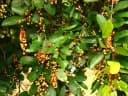
Antidesma bunius
Antidesma bunius
Safety & Hazards
The bark contains a toxic alkaloid[1].
Cultivation Details
Bignay grows best in the hot, humid tropical lowlands[2, 3]. It thrives at elevations up to 1,200 metres in Java[1]. The tree is not strictly tropical for it has proved to be hardy up to central Florida[1]. Plants can tolerate occasional light frosts[3]. Grows best in a sunny position or light shade in a fertile, moisture-retentive soil[4]. Plants can succeed in a variety of soil conditions[3]. Prefers a pH in the range 6 - 7, tolerating 5.5 - 8[5]. Wind-protection is desirable when the trees are young[1]. An abundant and invasive species in the Philippines[1]. Trees can start producing fruit in 5 - 6 years from seed, or as little as 2 - 3 years from grafted plants[3]. The heavy fragrance of the flowers, especially the male, is very obnoxious to some people[1]. Plants are dioecious - there are separate male and female forms. However, female forms fruit freely even when there is no male present for pollination[2]. One male tree should be planted for every 10 to 12 females to provide cross-pollination[1].
Propagation
Seed - Whenever the seeds are used, they need about one month of after-ripening and can then be sown under shade without pre-treatment[1]. Fresh seeds need pre-treatment with sulphuric acid for 15 min followed by soaking in water for 24 hours[1]. The viability is about 3 - 70%[1]. Depulped and dried fruits of A.bunius may be stored for 2 - 5 years in airtight containers without a serious decrease in seed viability[1]. Vegetative propagation is preferred because seedlings are of uncertain sex and they do not commence cropping for a number of years[1]. Greenwood cuttings. Air layering. Plants can begin producing when three years old[1]. Grafting. Cite as: Tropical Plants Database, Ken Fern. tropical.theferns.info. 2026-02-19. <tropical.theferns.info/viewtropical.php?id=Antidesma+bunius>
Pollinators
Flies, insects
References
- [1]World Agroforesty Centre — http://www.worldagroforestry.org/ ↩︎An excellent online database of a huge range of trees giving very good information on each plant - its uses, ecology, identity, propagation, pests etc.
- [2]The New RHS Dictionary of Gardening. 1992. — Huxley. A. · MacMillan Press · 1992 · ISBN 0-333-47494-5 ↩︎Excellent and very comprehensive, though it contains a number of silly mistakes. Readable yet also very detailed.
- [3]Perennial Edible Fruits of the Tropics : an Inventory — Martin, F. W.; Campbell, C. W.; Rubertbe, R. M. · U.S. Dept. of Agriculture, Agricultural Research Service · 1987 ↩︎A booklet giving terse details of almost 300 species of edible fruits, plus regional lists of Botanical and Common names for over 2,500 less well-known edible fruits of the tropics.
- [4]Tropical and Subtropical Trees - A Worldwide Encyclopaedic Guide. — Barwick. M. · Thames & Hudson, London · 2004 · ISBN 0-500-51181-0 ↩︎A superb book, very concise and well written, giving a wealth of information on 400 or more species including descriptions, habitat, cultivation details and plant uses. A wealth of colour photographs bring each plant vividly to life.
- [5]Ecocrop — http://ecocrop.fao.org/ecocrop/srv/en/home ↩︎Basic information on a wide range of useful plants, plus details of environmental needs where available.
- [6]Euphorbiaceae of Malesia — http://www.nationaalherbarium.nl/euphorbs/ ↩︎An online resource that is still being developed, it gives detailed botanical descriptions of plants in the family Euphorbiaceae found growing in Malesia (the region from Peninsual Malaysia through Indonesia, the Philippines).
- [7]Plant Resources of Southeast Asia — http://proseanet.org/ ↩︎Lots of information on the uses of the plants of SE Asia.
- [8]Cornucopia II — Facciola. S. · Kampong Publications, California. · 1998 · ISBN 0-9628087-2-5 ↩︎The second edition of an excellent guide to the edible uses of plants, though it does not give any details of cultivation etc.
- [9]Edible Leaves of the Tropics — Martin. F. W.; Ruberte. R. M. & Meitzner. L. S. · Echo. USA. · 1998 · ISBN 0-9653360-1-8 ↩︎A terse guide, giving reasonable detail on the more common leaf crops and brief information on a wide range of lesser known plants.
- [10]Flora of China — Missouri Botanical Garden Press; St. Louis. · 1994 · http://flora.huh.harvard.edu/china/ ↩︎An excellent, comprehensive resource in 25 volumes. In addition to the botanical information the flora also gives basic information on habitat and some uses. An on-line version is also available.