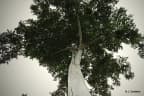
Antiaris toxicaria
Antiaris toxicaria
Safety & Hazards
A latex obtained from the bark contains varying amounts of cardiac glycosides and can be very poisonous[1]. The latex is one of the principle components of most dart and arrow poisons in South-East Asia[2]. Though the latex is known to be highly poisonous if injected into the blood stream (which is used widely in SE Asia by hunting communities), if swallowed its toxic properties are apparently not effective[3]. The sawdust from the wood may cause skin irritation and occupational asthma[2].
Cultivation Details
Bark cloth tree is a plant of tropical areas, where it can be found in a wide range of environmental conditions from semi arid to rainforest and even in swamp forests[4]. Succeeds in most soil types, preferring well-drained conditions[2]. Requires a sunny position[2]. Seedlings are usually abundant near the mother tree, but experience high mortality in the first year[2]. In the shade of the forest, seedlings up to 40cm tall are common, but exposure to full light is required for further growth[2]. Under exposed conditions, the tree can grow rapidly; growth rates of 50 cm/year in height are common in abandoned farmland[2]. The latex yield of a scarred tree may be 100 - 500g in 2 days[4]. Plants are not very tolerant of fire[4]. Bark cloth tree is regarded as a single species with 5 subspecies; subsp. Toxicaria and macrophylla occur within the Malesian region[5]. In Africa this tree has three varieties, which are africana, humbertii and welwitschii. They are clearly distinguished by their habitat preferences and juvenile forms. While one is found largely in wooded grassland, the others grow in rain forest, wetter forest, riverine and semi-swamp forests[5].
Propagation
Seed - when sown fresh, the seed has a high germination rate of up to 94% within 2.5 - 13 weeks[2]. Under natural conditions, the seeds lose viability rapidly, but when stored in wet sand at low temperatures they still may have a germination rate of 82% after 5 months[2]. Cite as: Tropical Plants Database, Ken Fern. tropical.theferns.info. 2026-02-19. <tropical.theferns.info/viewtropical.php?id=Antiaris+toxicaria>
Pollinators
Data unavailable
References
- [1]Flora of China — Missouri Botanical Garden Press; St. Louis. · 1994 · http://flora.huh.harvard.edu/china/ ↩︎An excellent, comprehensive resource in 25 volumes. In addition to the botanical information the flora also gives basic information on habitat and some uses. An on-line version is also available.
- [2]Protabase - Plant Resources of Tropical Africa. — http://www.prota.org ↩︎An excellent on-line database with detailed information on over 3,200 species of useful plants of Africa.
- [3]Flora of Australia — http://www.anbg.gov.au/abrs/abif/flora/ ↩︎The full information from the Flora of Australia - on-line. An excellent resource.
- [4]Plant Resources of Southeast Asia — http://proseanet.org/ ↩︎Lots of information on the uses of the plants of SE Asia.
- [5]World Agroforesty Centre — http://www.worldagroforestry.org/ ↩︎An excellent online database of a huge range of trees giving very good information on each plant - its uses, ecology, identity, propagation, pests etc.
- [6]Medicinal Plants in Papua New Guinea — World Health Organisation · 2009 · ISBN 978-92-9061-249-0 ↩︎Traditional medicinal uses of 126 species from Papua New Guinea, including information on modern research into the plants.
- [7]Flora Zambesiaca — http://apps.kew.org/efloras/fz/intro.html ↩︎An excellent online flora of plants from the Zambezi River basin. It lists a number of the plant uses as well as the habitats and botanical descriptions of the plants.
- [8]Useful Fiber Plants of the World — Dodge C.R. · USDA; Washington. · 1897 · http://www.biodiversitylibrary.org/ ↩︎A rather dated, but very comprehensive catalogue of fibre plants from around the world. The book can be downloaded from the Internet.
- [9]Tropix 7 — CIRAD · http://tropix.cirad.fr/en ↩︎An on-line guide to the timbers of 245 species of trees.