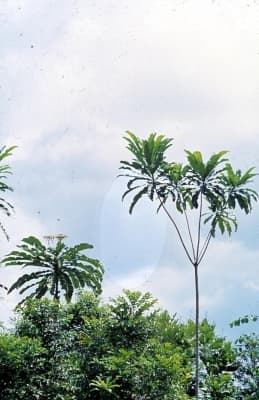
Gentianaceae FAMILY
Anthocleista nobilis
Anthocleista nobilis
Edibility
0/5
Medicinal
3/5
Cultivation Details
HabitTree
Growth—
A plant of the moister, mainly lowland tropics, where it is found at elevations up to 1,200metres. It grows best in areas where annual daytime temperatures are within the range 22 - 30°c, but can tolerate 14 - 35°c[2]. It prefers a mean annual rainfall in the range 1,100 - 2,000mm, but tolerates 700 - 3,000mm[2]. Grows best in a sunny position[2]. Succeeds in a range of soils, preferring one that is well-drained soil[1]. Prefers a pH in the range 5.5 - 6.5, tolerating 5 - 7[2]. The plant flowers throughout the year[1].
Propagation
Seed - Cite as: Tropical Plants Database, Ken Fern. tropical.theferns.info. 2026-02-19. <tropical.theferns.info/viewtropical.php?id=Anthocleista+nobilis>
Pollinators
Data unavailable
References
- [1]Protabase - Plant Resources of Tropical Africa. — http://www.prota.org ↩︎An excellent on-line database with detailed information on over 3,200 species of useful plants of Africa.
- [2]Ecocrop — http://ecocrop.fao.org/ecocrop/srv/en/home ↩︎Basic information on a wide range of useful plants, plus details of environmental needs where available.
- [3]Dictionary of Economic Plants. — Uphof. J. C. Th. · Weinheim · 1959 · ISBN - ↩︎An excellent and very comprehensive guide but it only gives very short descriptions of the uses without any details of how to utilize the plants. Not for the casual reader.