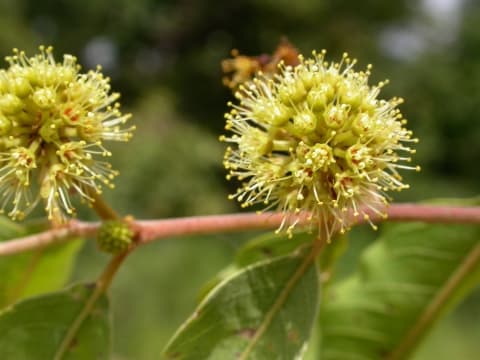
Anogeissus leiocarpa
Anogeissus leiocarpa
Safety & Hazards
None known
Cultivation Details
A plant of the African tropics, from lowland to moderate elevations, able to grow in semi-arid to much moister areas where annual rainfall can range from 200 - 1,200mm[1]. Prefers a moist, fertile soil[1]. Succeeds on a range of soils, including compact clays[2]. Prefers an acid pH[3]. A slow-growing tree, it flowers year-round but most abundantly at the beginning of the rainy season[1]. The flowers have a strong sweet smell[1]. The tree can be pollarded and has some ability to coppice[1]. It is very sensitive to fire[1, 4]. In regions where African birch is collected, the harvesting contributes to the growing scarcity of the tree populations, which is exacerbated because little rejuvenation appears to be taking place[1]. The tree used to occupy whole forests on fertile soils but it is becoming rarer because land is being cleared for agriculture, wood is collected for timber and fuel and the seeds are difficult to germinate[1].
Propagation
The seeds are very small and soon lose their viability (within 6 months); in addition, their germinating capacity is rather low, with only 10 - 15% of the seed proving to be viable[1, 2]. The germination of the seeds takes a long time and seedlings are not easy to obtain. Cite as: Tropical Plants Database, Ken Fern. tropical.theferns.info. 2026-02-19. <tropical.theferns.info/viewtropical.php?id=Anogeissus+leiocarpa>
Pollinators
Data unavailable
References
- [1]Protabase - Plant Resources of Tropical Africa. — http://www.prota.org ↩︎An excellent on-line database with detailed information on over 3,200 species of useful plants of Africa.
- [2]Seed Leaflets — Various · Forest & Landscape. Denmark · http://en.sl.life.ku.dk/Publikationer/Udgivelser/PopulaerPublikationer.aspx?katid={D28373CC-6EF3-4EF8-B097-6D83FABF209E}&serieid={9F1C3DB1-6E7B-4CF1-AF53-F480B0CB40EF}&sort=title ↩︎A series of leaflets, jointly produced by the University of Copenhagen and the Royal Botanic Gardens at Kew, focussing on seed information for a number species, but also giving a lot of other information about each plant.
- [3]The Useful Plants of West Tropical Africa. — Burkil. H. M. · Royal Botanic Gardens; Kew. · 1985 - 2004 ↩︎Brief descriptions and details of the uses of over 4,000 plants. A superb, if terse, resource, it is also available electronically on the Web - see http://www.aluka.org/
- [4]Trees and Shrubs of the Sahel. Their Characteristics and Uses. — von Maydell H. · Deutsche Gesellschaft fur Technische Zusammenarbeit; Germany · 1990 · ISBN 3-8236-1198-4 ↩︎A well-researched book, usually with more than one photograph of each species and good information on the plant and its uses.
- [5]Cornucopia II — Facciola. S. · Kampong Publications, California. · 1998 · ISBN 0-9628087-2-5 ↩︎The second edition of an excellent guide to the edible uses of plants, though it does not give any details of cultivation etc.
- [6]Traditional Vegetables in Benin — Achigan-Dako E. Et al · Darwin Initiative; International Foundation for Science · 2009 ↩︎Issued as a PDF on the Internet, it contains basic information on over 250 species of plants used for food in Benin.