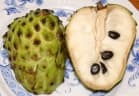
Annona × atemoya
Annona × atemoya
Safety & Hazards
None known
Cultivation Details
In the tropics the tree is only grown at elevations above 1,000 metres and will not survive under lowland conditions. It is grown in the lowlands in the subtropics. It grows best in areas where annual daytime temperatures are within the range 24 - 28°c, but can tolerate 12 - 32°c[1]. Plants can tolerate occasional light frosts[2]. Young trees will not tolerate prolonged temperatures between -3.9 to -6.7°c, whereas mature trees can withstand those temperatures with slight to moderate damage[1]. It prefers a mean annual rainfall in the range 2,000 - 3,000mm, but tolerates 600 - 4,200mm[1]. Prefers a moist, sandy loam with a pH around 6[3]. Tolerant of a range of soil conditions[2]. Requires a moist but well-drained soil[4, 5]. Prefers a pH in the range 5.5 - 6.5, tolerating 5 - 7[1]. Trees start producing fruit when about 4 - 5 years old from seed, or about 2 - 3 years after grafting[2]. Mature trees produce from 23 - 34 kg per tree, possibly more with good management, or 5 - 20 tonnes/ha per year[1]. Plants sometimes have two distinct flowering periods each year[2]. Fruiting is improved if the flowers are hand pollinated[4]. The fruit has good shipping qualities[6]. There are many named varieties[7].
Propagation
Seed - normally only used to produce plants used as rootstocks[4]. The seed usually germinates in about 4 weeks[4]. Semi-ripe cuttings[3]. Grafting Cite as: Tropical Plants Database, Ken Fern. tropical.theferns.info. 2026-02-19. <tropical.theferns.info/viewtropical.php?id=Annona+%C3%97+atemoya>
Pollinators
Beetles
References
- [1]Ecocrop — http://ecocrop.fao.org/ecocrop/srv/en/home ↩︎Basic information on a wide range of useful plants, plus details of environmental needs where available.
- [2]Perennial Edible Fruits of the Tropics : an Inventory — Martin, F. W.; Campbell, C. W.; Rubertbe, R. M. · U.S. Dept. of Agriculture, Agricultural Research Service · 1987 ↩︎A booklet giving terse details of almost 300 species of edible fruits, plus regional lists of Botanical and Common names for over 2,500 less well-known edible fruits of the tropics.
- [3]The New RHS Dictionary of Gardening. 1992. — Huxley. A. · MacMillan Press · 1992 · ISBN 0-333-47494-5 ↩︎Excellent and very comprehensive, though it contains a number of silly mistakes. Readable yet also very detailed.
- [4]Fruits of Warm Climates — Morton. J. · Florida Flair books, Florida. · 1987 · ISBN 0961018410 ↩︎A very well written guide to about 125 species.
- [5]Trade Winds Fruit — http://www.tradewindsfruit.com/index.htm ↩︎The on-line catalogue of a company selling seeds. Gives descriptions, photos and uses of a very wide range of fruit and other food-producing plants plus ornamentals.
- [6]Dictionary of Economic Plants. — Uphof. J. C. Th. · Weinheim · 1959 · ISBN - ↩︎An excellent and very comprehensive guide but it only gives very short descriptions of the uses without any details of how to utilize the plants. Not for the casual reader.
- [7]Cornucopia II — Facciola. S. · Kampong Publications, California. · 1998 · ISBN 0-9628087-2-5 ↩︎The second edition of an excellent guide to the edible uses of plants, though it does not give any details of cultivation etc.