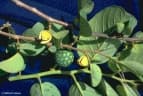
Annona senegalensis
Annona senegalensis
Safety & Hazards
None known
Cultivation Details
Wild custard apple grows naturally in semi-arid to humid tropical areas of Africa at elevations ranging from sea level to 2,400 metres[1]. It grows best in areas where the mean annual temperature is in the range 17 - 30°c and the mean annual rainfall is 700 - 2,500mm[1]. Although it succeeds on various soil types, it grows best on coral rocks dominated by sandy loam soils[1]. Prefers a position in light shade[1]. Prefers a pH in the range 5.5 - 7, tolerating 5 - 7.5[2]. The flowers of Annona genus are hermaphrodite, but the stigmas are generally not receptive at the time the pollen is shed. Complete pollination seldom occurs, explaining the frequency of misshapen fruits[1]. Hand pollination may improve both yield and quality of the fruit[1]. Fruit cracking is common[1]. Trees coppice well after felling and also send up sucker shoots[1, 3].
Propagation
Seed - scarification improves germination rates of nursery grown plants[1]. Natural regeneration by seed is usually good, especially on recently cultivated or burnt areas of land[1]. Seed storage behaviour is orthodox. Seeds are susceptible to insect damage and lose viability within 6 months[1]. However, viability can be maintained for more than 2 years in air-dry storage at 5c[1]. Root suckers are produced naturally by the plant in conditions such as the wounding of roots by fire, or trampling by cultivators and animals[1]. Cite as: Tropical Plants Database, Ken Fern. tropical.theferns.info. 2026-02-19. <tropical.theferns.info/viewtropical.php?id=Annona+senegalensis>
Pollinators
Beetles
References
- [1]World Agroforesty Centre — http://www.worldagroforestry.org/ ↩︎An excellent online database of a huge range of trees giving very good information on each plant - its uses, ecology, identity, propagation, pests etc.
- [2]Ecocrop — http://ecocrop.fao.org/ecocrop/srv/en/home ↩︎Basic information on a wide range of useful plants, plus details of environmental needs where available.
- [3]Edible Wild Plants of Tanzania — Ruffo, C.K.: Birnie, A. & Tengnas, B. · Regional Land Management Unit; Nairobi. · 2002 · ISBN 9966-896-60-0 ↩︎A very well presented, simple guide to growing and utilizing wild food plants in Tanzania, with line drawings of each plant, a description, habitat and range, non-food as well as food uses, plus basic information on growing the plants.
- [4]Dictionary of Economic Plants. — Uphof. J. C. Th. · Weinheim · 1959 · ISBN - ↩︎An excellent and very comprehensive guide but it only gives very short descriptions of the uses without any details of how to utilize the plants. Not for the casual reader.
- [5]IUCN Red List of Threatened Species — http://www.iucnredlist.org/ ↩︎A list of plants under threat and facing possible extinction, usually with brief details of the threats and information on habitat.
- [6]Flora Zambesiaca — http://apps.kew.org/efloras/fz/intro.html ↩︎An excellent online flora of plants from the Zambezi River basin. It lists a number of the plant uses as well as the habitats and botanical descriptions of the plants.
- [7]Cornucopia II — Facciola. S. · Kampong Publications, California. · 1998 · ISBN 0-9628087-2-5 ↩︎The second edition of an excellent guide to the edible uses of plants, though it does not give any details of cultivation etc.
- [8]Perennial Edible Fruits of the Tropics : an Inventory — Martin, F. W.; Campbell, C. W.; Rubertbe, R. M. · U.S. Dept. of Agriculture, Agricultural Research Service · 1987 ↩︎A booklet giving terse details of almost 300 species of edible fruits, plus regional lists of Botanical and Common names for over 2,500 less well-known edible fruits of the tropics.
- [9]Traditional Vegetables in Benin — Achigan-Dako E. Et al · Darwin Initiative; International Foundation for Science · 2009 ↩︎Issued as a PDF on the Internet, it contains basic information on over 250 species of plants used for food in Benin.
- [10]Trees and Shrubs of the Sahel. Their Characteristics and Uses. — von Maydell H. · Deutsche Gesellschaft fur Technische Zusammenarbeit; Germany · 1990 · ISBN 3-8236-1198-4 ↩︎A well-researched book, usually with more than one photograph of each species and good information on the plant and its uses.
- [PFAF]Plants for a Future — pfaf.org ↩︎