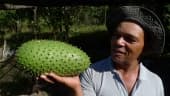
Cultivation Details
Annona muricata grows best in the moist, humid tropical and subtropical lowlands at elevations up to about 1,000 metres[3, 4]. It prefers a mean annual temperature in the range 25 - 30°c with a mean annual rainfall in the range 1,000 - 2,500mm. The plant is intolerant of frosts[3, 5]. Grows best in a sunny position[1]. Prefers a moist but well-drained, sandy loam with a pH in the range 5.5 - 6.5[6, 3, 7]. Prefers a deep rich loam[3, 4], but tolerates poor soils[5]. Succeeds in light-textured, alkaline soils[1, 7]. Established plants are very drought tolerant[1]. The plant is widely cultivated as a fruit crop and sometimes escapes from cultivation. Whilst currently assessed as having a low potential for becoming an invasive species, there are some Pacific Islands where it has been reported to be moderately invasive[5]. The leaves have an aroma similar to blackcurrants. Flowers are protandrous, and the pollen is shed as the outer petals open towards the evening. The inner petals open much later and only very slightly, admitting small insects attracted by the fragrance of the flowers. Presumably these insects effect cross-pollination, though rather inadequately, for few flowers set fruit and many fruits are misshapen since numerous ovules are not fertilized. Hand pollination is effective in improving fruit yield and quality[3]. Sporadic flowering and fruiting can occur all year round in favourable conditions[3]. Fruiting starts in the 2nd year, and 5-year-old trees produce 10 - 50 fruits, depending on pollination efficiency and nutrient status[3]. There are many named varieties[8]. The area around the base of the tree should be kept free from weeds or covered with mulch to avoid dehydration of the shallow roots during the dry season[3]. Annona muricata can tolerate dry soil conditions, but the trees shed too many leaves if they experience prolonged drought[3].
Propagation
Seed - usually breeds true to type[6]. Sow in individual pots, not deeper than 2cm, at 21c[6]. Seeds may be sown directly into the field or in a nursery bed[3]. The seed of many species in this genus has a hard seedcoat and may benefit from scarification before sowing in order to speed up germination. This can usually be done by pouring a small amount of nearly boiling water on the seeds (being careful not to cook them!) and then soaking them for 12 - 24 hours in warm water. By this time they should have imbibed moisture and swollen - if they have not, then carefully make a nick in the seedcoat (being careful not to damage the embryo) and soak for a further 12 hours before sowing[PFAF]. Semi-ripe cuttings[6]. Cite as: Tropical Plants Database, Ken Fern. tropical.theferns.info. 2026-02-19. <tropical.theferns.info/viewtropical.php?id=Annona+muricata>
Pollinators
Flies, Beetles, Insects
References
- [1]Tropical and Subtropical Trees - A Worldwide Encyclopaedic Guide. — Barwick. M. · Thames & Hudson, London · 2004 · ISBN 0-500-51181-0 ↩︎A superb book, very concise and well written, giving a wealth of information on 400 or more species including descriptions, habitat, cultivation details and plant uses. A wealth of colour photographs bring each plant vividly to life.
- [2]Medicinal Plants of the Guianas — DeFilipps, R. A.; Maina, S. L.; & Crepin, J. · Smithsonian Museum · http://botany.si.edu/bdg/medicinal/index.html ↩︎A down-loadable PDF document of a book in pre-publication awaiting illustration. An excellent, if rather terse, guide to the traditional medicinal uses of the plants of the region
- [3]World Agroforesty Centre — http://www.worldagroforestry.org/ ↩︎An excellent online database of a huge range of trees giving very good information on each plant - its uses, ecology, identity, propagation, pests etc.
- [4]Under-Utilized Tropical Fruits of Thailand. RAP — Suranant Subhadrabandhu · F. A. O., The United Nations, Bangkok. · 2001 · http://www.fao.org/3/a-ab777e.pdf ↩︎A detailed report on 35 fruit species that could have potential for increased production in Thailand. The report can be downloadd as a PDF from the internet.
- [5]Invasive Species Compendium — http://www.cabi.org ↩︎An immense resource - in depth information on over 900 species of invasive plants (it also has information on animals, fungi etc).
- [6]The New RHS Dictionary of Gardening. 1992. — Huxley. A. · MacMillan Press · 1992 · ISBN 0-333-47494-5 ↩︎Excellent and very comprehensive, though it contains a number of silly mistakes. Readable yet also very detailed.
- [7]Digital Compendium of Forestry Species of Cambodia — www.digitalspecies.blogspot.com; Phnom Penh · 2008 · http://www.digitalspecies.blogspot.com ↩︎A very detailed booklet, produced in PDF format on the internet, giving information on around 100 species of trees.
- [8]Cornucopia II — Facciola. S. · Kampong Publications, California. · 1998 · ISBN 0-9628087-2-5 ↩︎The second edition of an excellent guide to the edible uses of plants, though it does not give any details of cultivation etc.
- [9]Trees Commonly Cultivated in SE Asia — Jensen. M. · FAO Regional Office, Bangkok. · 1999 · ISBN 974-89377-5-5 ↩︎
- [10]Mansfeld's Database of Agricultural and Horticultural Plants — http://mansfeld.ipk-gatersleben.de/pls/htmldb_pgrc/f?p=185:3:4292127278597336 ↩︎Terse details of a huge range of useful plants.
- [11]IUCN Red List of Threatened Species — http://www.iucnredlist.org/ ↩︎A list of plants under threat and facing possible extinction, usually with brief details of the threats and information on habitat.
- [12]Medicinal Plants in the South Pacific — WHO Regional Publications, Manilla. · 1998 · ISBN 92-9061-118-9 ↩︎Excellent guide to 102 medicinal herbs of the Pacific Islands, with photographs of each plant and details of their constituents, biological activities and traditional uses. A description of each plant, together with habitat and distribution is given.
- [13]Food Plants in the Americas: A Survey of the Domesticated, Cultivated, and Wild Plants Used for Human Food in North, — Kermath B.M.; Bennett B.C.' Pulsipher L.M. · 2014 ↩︎A pre-publication draft of an amazing, on-going work first started in 1985. It contains information on more than 3,900 taxa from the Americas - from Arctic regions to the Tropics
- [14]Woods of Northeastern Peru — Williams L. · Field Museum Press; Chicago. · 1936 · http://www.biodiversitylibrary.org/ ↩︎Gives information on the properties of the wood of well over 1,000 species of woody plants from northeastern Peru. Can be downloaded from the Internet.
- [PFAF]Plants for a Future — pfaf.org ↩︎