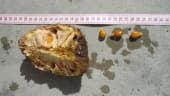
Annona montana
Annona montana
Safety & Hazards
None known
Cultivation Details
A plant of the moist tropics, where it can be grown at elevations from near sea level up to 2,000 metres[1, 2]. It grows best in areas where annual daytime temperatures are within the range 16 - 26°c, but can tolerate 14 - 32°c[2]. Mature plants can be killed by temperatures of -4°c or lower, but new growth can be badly damaged at -1°c[2]. It prefers a mean annual rainfall in the range 900 - 1,700mm, but tolerates 640 - 4,000mm[2]. Grows best in a sunny position[2]. Tolerant of a wide range of well-drained, fertile soils[2], but prefers a moist, sandy loam with a pH in the range 5.5 - 6.5[3, 4]. Prefers a pH in the range 5.5 - 7, tolerating 5 - 8.7[2]. The tree resembles the soursop (A. Muricata), but is less susceptible to cold, being able to be grown at higher elevations[5, 6]. Trees take 5 - 6 years from seed until they begin to produce fruit[1]. Trees can start to produce fruit when only 2 - 3 years old[7]. In some areas the tree can flower and produce fruit all year round[8]. The outer bark has a pungent smell[9].
Propagation
Seed - usually breeds true to type[3]. Sow in individual pots, not deeper than 2cm, at 21c[3]. Seeds may be sown directly into the field or in a nursery bed[4]. The seed of many species in this genus has a hard seedcoat and may benefit from scarification before sowing in order to speed up germination. This can usually be done by pouring a small amount of nearly boiling water on the seeds (being careful not to cook them!) and then soaking them for 12 - 24 hours in warm water. By this time they should have imbibed moisture and swollen - if they have not, then carefully make a nick in the seedcoat (being careful not to damage the embryo) and soak for a further 12 hours before sowing[PFAF]. Semi-ripe cuttings[3]. Cite as: Tropical Plants Database, Ken Fern. tropical.theferns.info. 2026-02-19. <tropical.theferns.info/viewtropical.php?id=Annona+montana>
Pollinators
Beetles, Insects
References
- [1]Perennial Edible Fruits of the Tropics : an Inventory — Martin, F. W.; Campbell, C. W.; Rubertbe, R. M. · U.S. Dept. of Agriculture, Agricultural Research Service · 1987 ↩︎A booklet giving terse details of almost 300 species of edible fruits, plus regional lists of Botanical and Common names for over 2,500 less well-known edible fruits of the tropics.
- [2]Ecocrop — http://ecocrop.fao.org/ecocrop/srv/en/home ↩︎Basic information on a wide range of useful plants, plus details of environmental needs where available.
- [3]The New RHS Dictionary of Gardening. 1992. — Huxley. A. · MacMillan Press · 1992 · ISBN 0-333-47494-5 ↩︎Excellent and very comprehensive, though it contains a number of silly mistakes. Readable yet also very detailed.
- [4]World Agroforesty Centre — http://www.worldagroforestry.org/ ↩︎An excellent online database of a huge range of trees giving very good information on each plant - its uses, ecology, identity, propagation, pests etc.
- [5]Cornucopia II — Facciola. S. · Kampong Publications, California. · 1998 · ISBN 0-9628087-2-5 ↩︎The second edition of an excellent guide to the edible uses of plants, though it does not give any details of cultivation etc.
- [6]Plant Resources of Southeast Asia — http://proseanet.org/ ↩︎Lots of information on the uses of the plants of SE Asia.
- [7]Trade Winds Fruit — http://www.tradewindsfruit.com/index.htm ↩︎The on-line catalogue of a company selling seeds. Gives descriptions, photos and uses of a very wide range of fruit and other food-producing plants plus ornamentals.
- [8]Common Trees of Puerto Rico and the Virgin Islands — Little E.L.; Wadsworth F.H. · USDA, Forest Service; Washington. · 1964 ↩︎Contains detailed information, and usually an illustration, on 250 tree species, including both native and exotic species.
- [9]Non-timber forest products of the North-West District of Guyana — van Andel T.R. · Tropenbos-Guyana Programme; Georgetown, Guyana · 2000 · ISBN 90-393-2536-7 ↩︎A very detailed study of the peoples and the plants they use, it includes a field guide to almost 500 species of useful plants.
- [10]Brazilian Fruits and Cultivated Exotics — Lorenzi. H.; Bacher. L.; Lacerda. M.; Sartori. S. · Instituto Plantarum De Estudos Da Flora LTDA; Brazil. · 2000 · ISBN 85-867174-24-0 ↩︎A superb book, giving information on several hundred fruit species. Each entry has a brief description of the plant and its uses, accompanied by one to many excellent quality photographs of the fruits.
- [11]Mansfeld's Database of Agricultural and Horticultural Plants — http://mansfeld.ipk-gatersleben.de/pls/htmldb_pgrc/f?p=185:3:4292127278597336 ↩︎Terse details of a huge range of useful plants.
- [12]IUCN Red List of Threatened Species — http://www.iucnredlist.org/ ↩︎A list of plants under threat and facing possible extinction, usually with brief details of the threats and information on habitat.
- [13]Contributions from the United States National Herbarium Vol. 18 — Smithsonian Institute; Washington. · 1917 · http://www.biodiversitylibrary.org ↩︎Includes a treatment of the Annona. It can be downloaded from the Internet.
- [14]Revision of the Neotropical Genera Bocageopsis, Onychopetalum and Unonopsis (Annonaceae) — Maas P.J.M. et al · 2007 · http://dx.doi.org/10.3767/000651907X608909 ↩︎
- [15]Woods of Northeastern Peru — Williams L. · Field Museum Press; Chicago. · 1936 · http://www.biodiversitylibrary.org/ ↩︎Gives information on the properties of the wood of well over 1,000 species of woody plants from northeastern Peru. Can be downloaded from the Internet.
- [16]Enciclopedia de las Plantas Útiles del Ecuador — de la Torre, L., Navarrete H., P. Muriel M., Macía M.J. & Ba · Herbario QCA de la Escuela de Ciencias Biológicas de la Pontific · 2008 · ISBN 978-9978-77-135-8 ↩︎
- [17]Under-Utilized Tropical Fruits of Thailand. RAP — Suranant Subhadrabandhu · F. A. O., The United Nations, Bangkok. · 2001 · http://www.fao.org/3/a-ab777e.pdf ↩︎A detailed report on 35 fruit species that could have potential for increased production in Thailand. The report can be downloadd as a PDF from the internet.
- [18]Medicinal Plants of the Guianas — DeFilipps, R. A.; Maina, S. L.; & Crepin, J. · Smithsonian Museum · http://botany.si.edu/bdg/medicinal/index.html ↩︎A down-loadable PDF document of a book in pre-publication awaiting illustration. An excellent, if rather terse, guide to the traditional medicinal uses of the plants of the region
- [19]Food Plants in the Americas: A Survey of the Domesticated, Cultivated, and Wild Plants Used for Human Food in North, — Kermath B.M.; Bennett B.C.' Pulsipher L.M. · 2014 ↩︎A pre-publication draft of an amazing, on-going work first started in 1985. It contains information on more than 3,900 taxa from the Americas - from Arctic regions to the Tropics
- [20]Diccionario das Plantas Uteis do Brasil — Correa M.P. · Imprensa Nacional; Rio de Janeiro · 1926 ↩︎A massive work in 6 volumes giving details of the various uses of Brazilian plants.
- [PFAF]Plants for a Future — pfaf.org ↩︎