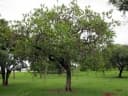
Annona crassiflora
Annona crassiflora
Safety & Hazards
The seeds are toxic[1].
Cultivation Details
Prefers a sunny position in a light sandy soil[2]. Established plants are drought tolerant[2]. A slow-growing tree[2]. The corky bark helps the tree to resist fires[2]. There is a form of this species where the fruit has a red pulp and has a sweeter flavour[2].
Propagation
Seed - it has a very hard outer layer and germinates much more easily if scarified[3]. This can usually be done by pouring a small amount of nearly boiling water on the seeds (being careful not to cook them!) and then soaking them for 12 - 24 hours in warm water. By this time they should have imbibed moisture and swollen - if they have not, then carefully make a nick in the seedcoat (being careful not to damage the embryo) and soak for a further 12 hours before sowing. Sow the seeds in a nursery seedbed in a lightly shaded position. Germination rates of scarified seeds are usually above 50%[3]. Cite as: Tropical Plants Database, Ken Fern. tropical.theferns.info. 2026-02-19. <tropical.theferns.info/viewtropical.php?id=Annona+crassiflora>
Pollinators
Beetles, Insects
References
- [1]Food Plants in the Americas: A Survey of the Domesticated, Cultivated, and Wild Plants Used for Human Food in North, — Kermath B.M.; Bennett B.C.' Pulsipher L.M. · 2014 ↩︎A pre-publication draft of an amazing, on-going work first started in 1985. It contains information on more than 3,900 taxa from the Americas - from Arctic regions to the Tropics
- [2]Brazilian Trees. Volume 2. 4th Edition. — Lorenzi. H. · Instituto Plantarum De Estudos Da Flora; Brazil. · 2002 · ISBN 85-86714-15-1 ↩︎Information on 350 species of Brazilian trees. Stunning photographs of each species, brief details on the plant, its uses and how to grow it from seed. A superb work, with the minor irritation that the translation from Portuguese is not of the best.
- [3]Brazilian Trees. Volume 3. — Lorenzi. H. · Instituto Plantarum De Estudos Da Flora; Brazil. · 2009 · ISBN 85-86714-34-4 ↩︎Information on 350 species of Brazilian trees. Stunning photographs of each species, brief details on the plant, its uses and how to grow it from seed. A superb work, with the minor irritation that the translation from Portuguese is not of the best.
- [4]World Agroforesty Centre — http://www.worldagroforestry.org/ ↩︎An excellent online database of a huge range of trees giving very good information on each plant - its uses, ecology, identity, propagation, pests etc.
- [5]Brazilian Fruits and Cultivated Exotics — Lorenzi. H.; Bacher. L.; Lacerda. M.; Sartori. S. · Instituto Plantarum De Estudos Da Flora LTDA; Brazil. · 2000 · ISBN 85-867174-24-0 ↩︎A superb book, giving information on several hundred fruit species. Each entry has a brief description of the plant and its uses, accompanied by one to many excellent quality photographs of the fruits.
- [6]Dictionary of Trees; Volume 2 South America; Nomenclature, Taxonomy and Ecology — Grandtner M.M. & Chevrette J. · Academic Press; London · 2014 · ISBN 978-0-12-396490-8 ↩︎
- [7]IUCN Red List of Threatened Species — http://www.iucnredlist.org/ ↩︎A list of plants under threat and facing possible extinction, usually with brief details of the threats and information on habitat.
- [8]Diccionario das Plantas Uteis do Brasil — Correa M.P. · Imprensa Nacional; Rio de Janeiro · 1926 ↩︎A massive work in 6 volumes giving details of the various uses of Brazilian plants.
- [9]Tree Species of Panama — http://ctfs.arnarb.harvard.edu/webatlas/mainframe.php?order=s ↩︎Factsheets on all the tree and shrub species of Panama, giving identification guide, brief guide to the species and some uses. A vast, but rather incomplete work as of 15/07/09.
- [10]Contributions from the United States National Herbarium Vol. 18 — Smithsonian Institute; Washington. · 1917 · http://www.biodiversitylibrary.org ↩︎Includes a treatment of the Annona. It can be downloaded from the Internet.
- [11]Medicinal Plants of Brazil — Mors W.B.; Rizzini C.T.; Pereira N.A. · Reference Publications; Michigan. · 2000 · ISBN 0-917256-42-5 ↩︎An extremely concise book, listing approximately 1,500 species and varieties of plants with their botanical name, common name in Brazil, regions in Brazil where the plant is found, a brief list of uses and any medically active compounds in the plant.
- [PFAF]Plants for a Future — pfaf.org ↩︎