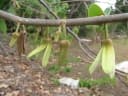
Annona cherimola
Annona cherimola
Safety & Hazards
Blindness can result from the juice of the crushed seeds coming in contact with the eyes[1]. The seeds and twigs contain several alkaloids including ( + )-reticuline, (-)-anonaine, liriodenine, and lanuginosine. Human ingestion of 0.15 g of the dark-yellow resin isolated from the seeds produces symptoms resembling the effects of atropine[1].
Cultivation Details
The cherimoya does not grow very well in lowland tropical areas, preferring elevations above 700 metres and growing well as high as 2,400 metres[1]. It can also be grown in subtropical and warm temperate basically frost-free areas, being able to tolerate occasional, short-lived light frosts. It prefers a mean annual rainfall within the range 1,000 - 1,700mm, though can tolerate as little as 600mm[2]. Prefers a moist, sandy loam with a pH around 6[3]. It grows well on a wide range of soil types from light to heavy, but seems to do best on a medium soil of moderate fertility[1]. It prefers a pH in the range 6.5 - 7.6[1]. The tree requires protection from strong winds that interfere with pollination and fruit set[1]. This species has often escaped from cultivation and has become widely naturalized in subtropical to tropical climates, occasionally being considered to be invasive in places such as Hawaii, Galapagos Islands, Easter Island and Kermadec Islands[3, 2]. The cherimoya begins to bear fruit when 3½ - 5 years old and production steadily increases from the 5th to the 10th year, when there should be a yield of 25 fruits/tree (5,000 per ha)[1]. In Colombia, the average yield is 25 fruits and in Italy, trees 30-35 years old produce 230-280 fruits annually[1]. A problem with the cherimoya is inadequate natural pollination because the male and female structures of each flower do not mature simultaneously. Few insects visit the flowers. Therefore, hand-pollination is highly desirable and must be done in a 6 - 8 hour period when the stigmas are white and sticky. It has been found in Chile that in the first flowers to open the pollen grains are loaded with starch, whereas flowers that open later have more abundant pollen, no starch grains, and the pollen germinates readily. Partly-opened flowers are collected in the afternoons and kept in a paper bag overnight. The next morning the shed pollen is put, together with moist paper, in a vial and transferred by brush to the receptive stigmas. Usually only a few of the flowers on a tree are pollinated each time, the operation being repeated every 4-5 days in order to extend the season of ripening. The closely related A. Senegalensis, if available, is a good source of abundant pollen for pollinating the cherimoya, that of the sugar apple is not satisfactory. Fruits from hand-pollinated flowers are normally superior in form and size[1].
Propagation
Seed - usually breeds true to type[3]. Sow in individual pots, not deeper than 2cm, at 21°c[3]. Cherimoya seeds remain viable for 2 - 3 years if kept dry and protected from weevils and fungi. At 20°c bottom heat, seeds germinate in about 21 days, but require about 40 days under normal ambient growing conditions[1]. The seed of many species in this genus has a hard seedcoat and may benefit from scarification before sowing in order to speed up germination. This can usually be done by pouring a small amount of nearly boiling water on the seeds (being careful not to cook them!) and then soaking them for 12 - 24 hours in warm water. By this time they should have imbibed moisture and swollen - if they have not, then carefully make a nick in the seedcoat (being careful not to damage the embryo) and soak for a further 12 hours before sowing[PFAF]. Semi-ripe cuttings[3]. Cuttings of mature wood have rooted in coral sand with bottom heat in 28 days[1]. Cite as: Tropical Plants Database, Ken Fern. tropical.theferns.info. 2026-02-19. <tropical.theferns.info/viewtropical.php?id=Annona+cherimola>
Pollinators
Beetles, Insects
References
- [1]World Agroforesty Centre — http://www.worldagroforestry.org/ ↩︎An excellent online database of a huge range of trees giving very good information on each plant - its uses, ecology, identity, propagation, pests etc.
- [2]Invasive Species Compendium — http://www.cabi.org ↩︎An immense resource - in depth information on over 900 species of invasive plants (it also has information on animals, fungi etc).
- [3]The New RHS Dictionary of Gardening. 1992. — Huxley. A. · MacMillan Press · 1992 · ISBN 0-333-47494-5 ↩︎Excellent and very comprehensive, though it contains a number of silly mistakes. Readable yet also very detailed.
- [4]Perennial Edible Fruits of the Tropics : an Inventory — Martin, F. W.; Campbell, C. W.; Rubertbe, R. M. · U.S. Dept. of Agriculture, Agricultural Research Service · 1987 ↩︎A booklet giving terse details of almost 300 species of edible fruits, plus regional lists of Botanical and Common names for over 2,500 less well-known edible fruits of the tropics.
- [5]Mansfeld's Database of Agricultural and Horticultural Plants — http://mansfeld.ipk-gatersleben.de/pls/htmldb_pgrc/f?p=185:3:4292127278597336 ↩︎Terse details of a huge range of useful plants.
- [6]Cornucopia II — Facciola. S. · Kampong Publications, California. · 1998 · ISBN 0-9628087-2-5 ↩︎The second edition of an excellent guide to the edible uses of plants, though it does not give any details of cultivation etc.
- [7]IUCN Red List of Threatened Species — http://www.iucnredlist.org/ ↩︎A list of plants under threat and facing possible extinction, usually with brief details of the threats and information on habitat.
- [8]Fruits of the Guianan Flora — van Roosmalen. M.G.M. · Institute of Systematic Boyany, Utrecht University; Netherlands. · 1985 · ISBN 90-9000988-4 ↩︎Terse descriptions of over 1,700 species from the Guianas that bear fruits - not necessarily edible! Often mentions if the fruit is edible, plus gives brief description of habit and habitat.
- [9]Enciclopedia de las Plantas Útiles del Ecuador — de la Torre, L., Navarrete H., P. Muriel M., Macía M.J. & Ba · Herbario QCA de la Escuela de Ciencias Biológicas de la Pontific · 2008 · ISBN 978-9978-77-135-8 ↩︎
- [10]Dictionary of Trees; Volume 2 South America; Nomenclature, Taxonomy and Ecology — Grandtner M.M. & Chevrette J. · Academic Press; London · 2014 · ISBN 978-0-12-396490-8 ↩︎
- [11]Food Plants in the Americas: A Survey of the Domesticated, Cultivated, and Wild Plants Used for Human Food in North, — Kermath B.M.; Bennett B.C.' Pulsipher L.M. · 2014 ↩︎A pre-publication draft of an amazing, on-going work first started in 1985. It contains information on more than 3,900 taxa from the Americas - from Arctic regions to the Tropics
- [PFAF]Plants for a Future — pfaf.org ↩︎