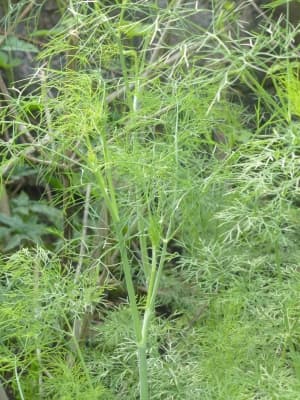
Cultivation Details
Dill is primarily a summer crop of temperate climates; in the tropics it grows better at elevations from 200 - 2,000 metres[2, 3]. It is generally considered a long-day plant in terms of flower initiation, with a critical period of 11 - 14 hours, though some reports indicate that it is probably day-neutral - long-day conditions merely enhancing anthesis. The annual rainfall or water requirement (irrigation) ranges from 500 - 1,700mm[3]. Areas with medium to heavy rainfall are preferred[2]. The plant does not tolerate frost, thriving when the monthly average temperatures is around 16 - 18°c. The minimum temperature for growth is about 7°c[3]. An easily grown plant[4], it prefers a moderately rich, loose soil[5, 6, 7]. Requires a well-drained soil[6] and shelter from the wind[8]. For best leaf production, plants prefer light shade when growing in the tropics[2]. Tolerates a pH in the range 5.3 to 7.8. A regular supply of leaves can be obtained if successional sowings are made throughout the year]. Dill is very intolerant of root disturbance and should not be transplanted because it will then quickly run to seed. There are many named varieties[9, 10]. 'Bouquet' is an American cultivar that has a prolific production of seeds[11]. The sub-species A. Graveolens sowa from India has a slightly different flavour to the type species[11]. The plant quickly runs to seed in dry weather[8]. It often self-sows when growing in a suitable position[12, 7]. A good companion for corn and cabbages, also in moderation for cucumbers, lettuce and onions, but it inhibits the growth of carrots[5, 13, 14]. Dill reduces a carrot crop if it is grown to maturity near them[15]. However, the young plant will help to deter carrot root fly[15]. Dill should not be grown near fennel because the two may hybridise, producing plants intermediate in flavour and appearance[16]. The flowers are very attractive to bees[5, 13, 14].
Propagation
Seed - sow mid spring to early summer in situ and only just cover[8, 11]. The seed germinates in 2 weeks if the soil is warm. Early sowings are best if a crop of seed is required[16]. A regular supply of leaves can be obtained if successional sowings are made from late spring to the end of early summer[17, 8]. Autumn sowings can succeed if the winters are mild[4]. Dill is very intolerant of root disturbance and should not be transplanted because it will then quickly run to seed. Cite as: Temperate Plants Database, Ken Fern. temperate.theferns.info. 2026-02-20. <temperate.theferns.info/plant/Anethum+graveolens>
Pollinators
Bees
References
- [1]Medicinal Plants of China — Duke. J. A. and Ayensu. E. S. · Reference Publications, Inc. · 1985 · ISBN 0-917256-20-4 ↩︎Details of over 1,200 medicinal plants of China and brief details of their uses. Often includes an analysis, or at least a list of constituents. Heavy going if you are not into the subject.
- [2]Vegetables in the Tropics — Tindall. H. D. · MacMillan, Oxford. · 1983 · ISBN 0-333-24268-8 ↩︎An excellent, in-depth look at the main vegetable crops that can be grown in the Tropics, plus many less well-known plants.
- [3]Plant Resources of Southeast Asia — http://proseanet.org/ ↩︎Lots of information on the uses of the plants of SE Asia.
- [4]A Modern Herbal. — Grieve. · Penguin · 1984 · ISBN 0-14-046-440-9 ↩︎Not so modern (1930's?) but lots of information, mainly temperate plants.
- [5]Complete Guide to Herbs. — Holtom. J. and Hylton. W. · Rodale Press · 1979 · ISBN 0-87857-262-7 ↩︎A good herbal.
- [6]The Vegetable Garden. — Vilmorin. A. · Ten Speed Press · ISBN 0-89815-041-8 ↩︎A reprint of a nineteenth century classic, giving details of vegetable varieties. Not really that informative though.
- [7]The Garden. Volume 112. — RHS. · Royal Horticultural Society · 1987 · ISBN - ↩︎Snippets of information from the magazine of the RHS. In particular, there are articles on plants that are resistant to honey fungus, oriental vegetables, Cimicifuga spp, Passiflora species and Cucurbits.
- [8]The New RHS Dictionary of Gardening. 1992. — Huxley. A. · MacMillan Press · 1992 · ISBN 0-333-47494-5 ↩︎Excellent and very comprehensive, though it contains a number of silly mistakes. Readable yet also very detailed.
- [9]Plants Consumed by Man. — Brouk. B. · Academic Press · 1975 · ISBN 0-12-136450-x ↩︎Readable but not very comprehensive.
- [10]Cornucopia - A Source Book of Edible Plants. — Facciola. S. · Kampong Publications · 1990 · ISBN 0-9628087-0-9 ↩︎Excellent. Contains a very wide range of conventional and unconventional food plants (including tropical) and where they can be obtained (mainly N. American nurseries but also research institutes and a lot of other nurseries from around the world.
- [11]Encyclopaedia of Herbs and their Uses. — Bown. D. · Dorling Kindersley, London. · 1995 · ISBN 0-7513-020-31 ↩︎A very well presented and informative book on herbs from around the globe. Plenty in it for both the casual reader and the serious student. Just one main quibble is the silly way of having two separate entries for each plant.
- [12]The Gardener's Assistant. — Thompson. B. · Blackie and Son. · 1878 · ISBN - ↩︎Excellent general but extensive guide to gardening practices in the 19th century. A very good section on fruits and vegetables with many little known species.
- [13]Companion Plants. — Philbrick H. and Gregg R. B. · Watkins · 1979 · ISBN - ↩︎Details of beneficial and antagonistic relationships between neighbouring plants.
- [14]Companion Planting for Successful Gardening. — Riotte. L. · Garden Way, Vermont, USA. · 1978 · ISBN 0-88266-064-0 ↩︎Fairly good.
- [15]A - Z of Companion Planting. — Allardice.P. · Cassell Publishers Ltd. · 1993 · ISBN 0-304-34324-2 ↩︎A well produced and very readable book.
- [16]The National Non-Food Crops Centre Crop Database — http://www.nnfcc.co.uk/crops/pd.cfm ↩︎An excellent on-line information source, with information on over 100 species (as of 2006) of plants being investigated as bio-crops.
- [17]Flowers of the Mediterranean. — Polunin. O. and Huxley. A. · Hogarth Press · 1987 · ISBN 0-7012-0784-1 ↩︎A very readable pocket flora that is well illustrated. Gives some information on plant uses.
- [18]Flowers of Europe - A Field Guide. — Polunin. O. · Oxford University Press · 1969 · ISBN 0192176218 ↩︎An excellent and well illustrated pocket guide for those with very large pockets. Also gives some details on plant uses.
- [19]Sturtevant's Edible Plants of the World. — Hedrick. U. P. · Dover Publications · 1972 · ISBN 0-486-20459-6 ↩︎Lots of entries, quite a lot of information in most entries and references.
- [20]Edible and Medicinal Plants. — Launert. E. · Hamlyn · 1981 · ISBN 0-600-37216-2 ↩︎Covers plants in Europe. a drawing of each plant, quite a bit of interesting information.
- [21]The Herb Book. — Lust. J. · Bantam books · 1983 · ISBN 0-553-23827-2 ↩︎Lots of information tightly crammed into a fairly small book.
- [22]Fruits of the Earth. — Bianchini. F., Corbetta. F. and Pistoia. M. ↩︎Lovely pictures, a very readable book.
- [23]Herbs — Phillips. R. & Foy. N. · Pan Books Ltd. London. · 1990 · ISBN 0-330-30725-8 ↩︎Deals with all types of herbs including medicinal, culinary, scented and dye plants. Excellent photographs with quite good information on each plant.
- [24]Encyclopaedia of Medicinal Plants. — Chiej. R. · MacDonald · 1984 · ISBN 0-356-10541-5 ↩︎Covers plants growing in Europe. Also gives other interesting information on the plants. Good photographs.
- [25]Dictionary of Economic Plants. — Uphof. J. C. Th. · Weinheim · 1959 · ISBN - ↩︎An excellent and very comprehensive guide but it only gives very short descriptions of the uses without any details of how to utilize the plants. Not for the casual reader.
- [26]Tanaka's Cyclopedia of Edible Plants of the World. — Tanaka. T. & Nakao S. · Keigaku Publishing; Tokyo · 1976 · ISBN - ↩︎The most comprehensive list of edible plants I've come across. Only the briefest entry for each species, though, and some of the entries are more than a little dubious. Not for the casual reader.
- [27]The Dictionary of Modern Herbalism. — Mills. S. Y. ↩︎An excellent small herbal.
- [28]Medicinal Plants of Nepal — Dept. of Medicinal Plants. Nepal. · 1993 · ISBN - ↩︎Terse details of the medicinal properties of Nepalese plants, including cultivated species and a few imported herbs.
- [29]The Encyclopedia of Medicinal Plants — Chevallier. A. · Dorling Kindersley. London · 1996 · ISBN 9-780751-303148 ↩︎An excellent guide to over 500 of the more well known medicinal herbs from around the world.